
iGenics Review: What’s on the Label and How It Compares to the AREDS2 Formula
Affiliate Disclosure: ThinkHealthTips may earn a commission if you purchase through links on this page, at no additional cost to you. This does not affect our editorial conclusions.
Quick answer: Is iGenics an AREDS2 formula?
On the label we reviewed, no. iGenics lists nine ingredients with every amount disclosed. Marketing describes it as an “AREDS-2 formula,” but the panel has no vitamin C, no zeaxanthin, and no copper. It has half the studied vitamin E and a different zinc and lutein dose. We found no studies of the finished product.
Evidence snapshot
- Evidence for key ingredients: Moderate for vitamin E, zinc, and lutein, but only as parts of the full AREDS2 formula in people with intermediate age-related macular degeneration (AMD). Mixed for bilberry.
- Finished-product evidence: Not identified in the sources reviewed.
- Transparency: All amounts disclosed. Third-party testing not verified.
- Main caution: The label does not match the AREDS2 formulation, and eye symptoms need an eye exam, not a supplement.
How we reviewed this product
We worked from a Supplement Facts image, compared it with the published AREDS2 formulation, and checked what research exists on the other ingredients. Where we couldn’t confirm something, we say so. Regulatory status and scientific evidence are treated separately. Last checked October 3, 2026.
About the author and medical review
Written by Shafeek, a contributor at ThinkHealthTips.
Medical review: This article has not been independently reviewed by a medical professional. It was researched using publicly available scientific literature, authoritative health sources, and product information. It is for general education and is not a substitute for individualized medical advice.
What is iGenics?
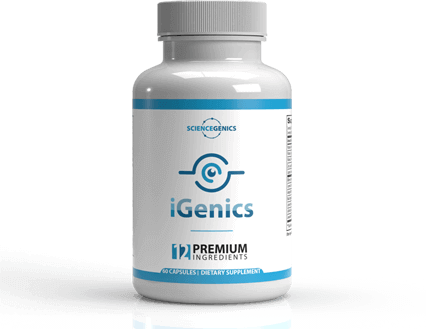
iGenics is a capsule supplement marketed for vision support. The label we reviewed lists a serving as 2 capsules, with 30 servings per container (60 capsules). The maker’s official product page (affiliate link) is where the current label and package options should be confirmed.
Limits of our source. Our label image comes from a retail listing and is cropped at the bottom, so we could not read the full “other ingredients” line (it begins with cellulose). We could not confirm the manufacturer, the formula version, or that this is the current US edition.
A discrepancy. Third-party pages describe iGenics as a “12-ingredient” formula. The label we reviewed lists nine. Either the label has changed, or the marketing is imprecise, and we can’t tell which.
What’s in it
| Ingredient | Amount per 2 capsules | %DV |
|---|---|---|
| Vitamin E (d-alpha tocopheryl acetate) | 200 IU | 665% |
| Zinc (aspartate) | 25 mg | 167% |
| Lutein | 20 mg | Not established |
| Bilberry extract (20% extract) | 80 mg | Not established |
| Grape seed extract (95%) | 100 mg | Not established |
| Quercetin | 100 mg | Not established |
| L-taurine | 400 mg | Not established |
| N-acetyl-L-cysteine | 200 mg | Not established |
| Lycopene | 3 mg | Not established |
There is no proprietary blend, which is a plus for transparency. Every amount is stated.
iGenics versus the AREDS2 formula
The AREDS2 clinical trial tested a specific combination. The National Eye Institute-based recommendation, as summarized by one university eye center, is 500 mg vitamin C, 400 IU vitamin E, 25 to 80 mg zinc, 2 mg copper, 10 mg lutein, and 2 mg zeaxanthin. The original AREDS formula added copper because high zinc intake is associated with copper deficiency anemia.
| Nutrient | AREDS2 | iGenics label | Match? |
|---|---|---|---|
| Vitamin C | 500 mg | None listed | No |
| Vitamin E | 400 IU | 200 IU | Half the dose |
| Zinc | 25 to 80 mg | 25 mg | Within the range cited |
| Copper | 2 mg | None listed | No |
| Lutein | 10 mg | 20 mg | Double the dose |
| Zeaxanthin | 2 mg | None listed | No |
Of the six AREDS2 nutrients, the label lacks three outright, halves another, and doubles a fifth. Only zinc falls inside the studied range. Even if the “AREDS-2” claim were meant loosely, the evidence from that trial can’t be transferred to this product.
Who the AREDS2 evidence applies to. The formulation was studied in people with intermediate AMD, or advanced AMD in one eye. One university eye center notes there is no scientific evidence that it prevents AMD in people without it or slows progression in mild cases. If you haven’t been diagnosed, that evidence doesn’t speak to you.
Ingredient evidence
Evidence for an ingredient isn’t evidence that this finished product works.
| Ingredient | Label amount | Studied range | Evidence label | Assessment |
|---|---|---|---|---|
| Vitamin E | 200 IU | 400 IU (AREDS2) | Moderate, within full formula | Half the studied dose and missing partners |
| Zinc | 25 mg | 25 to 80 mg | Moderate, within full formula | In range, but no copper alongside it |
| Lutein | 20 mg | 10 mg (AREDS2) | Moderate, within full formula | Double the studied dose; no zeaxanthin |
| Bilberry (20% extract) | 80 mg | Not compared | Mixed evidence | See below |
| Grape seed, quercetin, taurine, NAC, lycopene | See table above | Not compared | Not evaluated here | Summarized at label level only |
Bilberry. NCCIH reports that studies of bilberry and night vision have conflicting results, and that the most rigorous studies did not find it effective for night vision in healthy people. A systematic review of placebo-controlled trials reached a similar conclusion for normal night vision, while noting that a complete absence of rigorous research exists for people with impaired night vision from eye conditions.
We did not evaluate efficacy for grape seed, quercetin, taurine, NAC, or lycopene. That is a limitation of this review, not a finding that they lack research.
Does iGenics work?
We did not identify product-specific clinical evidence in the sources reviewed. That reflects what we found, not proof that none exists.
Marketing pages promise much more than the label supports. One sponsored article says the maker promises to revive vision in as little as seven days, and promotional pages include testimonials from a named customer. We can’t verify any of it. These are unsupported marketing claims and not evidence. Real vision problems, including blurry vision, need an eye exam. Some conditions, including AMD, progress without obvious early symptoms.
Is it safe? Side effects and interactions
- Zinc without copper. The AREDS formulation included copper specifically because high zinc intake is associated with copper deficiency. The label has 25 mg of zinc and no copper. That is below the commonly cited adult upper limit of 40 mg, but adding other zinc-containing supplements can push total intake higher.
- Bilberry. Safety data are limited, and one secondary source notes a potential interaction with anticoagulant or antiplatelet drugs. Ask a pharmacist if you take blood thinners.
- Quercetin, NAC, grape seed: we did not retrieve primary interaction sources for these, so treat that as something to raise with a pharmacist if you take regular medications.
- Lutein at 20 mg is double the AREDS2 amount. We did not retrieve a safety limit for it, so we make no claim either way.
Transparency and third-party testing
The label discloses all nine amounts, which is better than many supplements. We found no certificate of analysis or third-party certification (NSF, USP) for iGenics. Ask the maker for one.
On regulation, this review addresses the US market. Regulatory treatment of supplements differs by country, so readers elsewhere should check their own regulator. We did not query FDA databases for this product, so we can’t say anything about its FDA record. In the US, the rules for supplements are less strict than those for drugs, and a supplement being legally sold doesn’t make it effective.
Price, subscription, shipping, and refund
We couldn’t verify current pricing or the guarantee from the maker’s page as of October 3, 2026. Third-party pages disagree: one lists a single bottle at $59 plus shipping; others list $39 to $49 per bottle in multi-bottle bundles. These are unconfirmed claims. Confirm the current price and terms (affiliate link), the refund conditions, and whether you are agreeing to a subscription.
What we could verify and what remains uncertain
Verified from the label we saw: nine ingredients, their amounts, serving size, and servings per container.
Not verified: the manufacturer, whether this label is current, the full other-ingredients list, any finished-product studies, third-party testing, price and refund terms, and FDA status.
Who might consider it, and who should be cautious
A reader without a diagnosed eye condition who simply wants a general antioxidant supplement may find the transparent label acceptable, understanding that the evidence doesn’t show it protects vision. If you have intermediate AMD, talk to your eye doctor, because AREDS2-type formulas are specified closely and this label is not one. Be cautious if you take blood thinners, take other zinc supplements, or have a liver, kidney, or bleeding condition.
Final evidence-based assessment
What the evidence supports: the AREDS2 nutrients have moderate evidence only inside the full formula and only in people with intermediate AMD. Bilberry’s evidence for vision is mixed.
What it doesn’t establish: that iGenics protects or restores vision. It lacks half the AREDS2 components, and nothing we found tested the finished product.
Before buying, compare the label on the official product page (affiliate link) with the one reviewed here, especially whether vitamin C, zeaxanthin, or copper have been added. If your concern is AMD, ask an eye doctor which formulation suits you first.
Frequently asked questions
Is iGenics an AREDS2 formula?
Not on the label we reviewed. It lacks vitamin C, zeaxanthin, and copper, has 200 IU of vitamin E versus 400 IU, and has 20 mg of lutein versus 10 mg.
Does iGenics improve eyesight?
We did not identify evidence that the finished product does. Marketing claims of fast results are unverified.
Does bilberry help vision?
Evidence is mixed. NCCIH reports the most rigorous studies did not find it effective for night vision in healthy people.
Should I take zinc without copper?
The original AREDS formula added copper because high zinc intake is associated with copper deficiency. Ask your doctor or pharmacist about your own total intake.
References
- Chew EY et al. Lutein+Zeaxanthin and Omega-3 Fatty Acids for AMD: The AREDS2 Randomized Clinical Trial. JAMA. https://jamanetwork.com/journals/jama/article-abstract/1684847 (retrieved Oct 3, 2026)
- AREDS2 formulation table. https://pmc.ncbi.nlm.nih.gov/articles/PMC8348883/table/jcm-10-03297-t001 (retrieved Oct 3, 2026)
- University of Michigan Kellogg Eye Center. Dietary Supplements and AMD (summarizing NEI recommendations). https://umkelloggeye.org/conditions-treatments/dietary-supplements-and-age-related-macular-degeneration (secondary source; retrieved Oct 3, 2026)
- NCCIH. Bilberry. https://nccih.nih.gov/health/bilberry (retrieved Oct 3, 2026)
- Anthocyanosides of Vaccinium myrtillus (bilberry) for night vision, a systematic review of placebo-controlled trials. Surv Ophthalmol. 2004. https://pubmed.ncbi.nlm.nih.gov/14711439/ (retrieved Oct 3, 2026)
