
Audifort Review: 22 Ingredients Share One 200mg Blend
ThinkHealthTips may earn a commission if you purchase through links on this page, at no additional cost to you. This does not affect our editorial conclusions.
Quick answer: Does Audifort have evidence behind it?
We did not identify any studies of Audifort. Its label says it “supports healthy hearing,” but 22 ingredients share a single 200 mg blend with no individual amounts, so research on any one ingredient can’t be matched to what you’d take. Its label is identical to another product’s, Echoxen. Two ingredients carry safety cautions: a licorice-derived compound and green tea extract.
Evidence snapshot
- Evidence for key ingredients: Not assessable. Amounts are undisclosed, and we did not identify hearing-specific evidence for the blend’s ingredients in the sources reviewed.
- Finished-product evidence: Not identified in the sources reviewed.
- Transparency: One amount disclosed (chromium). Twenty-two ingredients sit inside one proprietary blend. Third-party testing not verified.
- Main caution: A compound related to licorice’s glycyrrhizin can affect blood pressure and potassium, and green tea extract has liver-safety reports, both at undisclosed amounts.
How we reviewed this product
We worked from a label image of the bottle, checked safety sources for the ingredients that raised concerns, and looked for evidence on supplements for hearing. We could not open the maker’s site, and third-party pages describe the product differently from its label, as noted below. Regulatory status and scientific evidence are kept separate. Read our Supplement Review Methodology page. Last checked October 3, 2026.
Medical review Status: This article has not been independently reviewed by a medical professional. It was researched using publicly available scientific literature, authoritative health sources, and product information. It is for general education and is not a substitute for individualized medical advice.
What is Audifort?
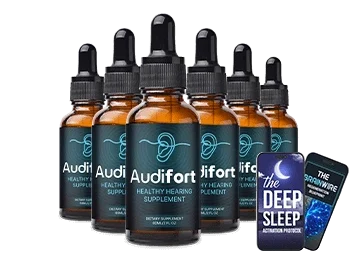
Audifort is a liquid dietary supplement in a 1 fl oz (30 mL) dropper bottle, labeled “Supports Healthy Hearing.” The label says it is distributed by audifort.com of Miami, Florida, and “made in the USA with globally sourced ingredients.” The maker’s official product page (affiliate link) shows current offers and variants.
The serving size is 1 mL, with 30 servings per container. The suggested use is “1 or 2 droppers full daily.” The label doesn’t state how many milliliters a dropper holds, so we can’t tell how long a bottle lasts or whether two droppers means two servings. One press-release-style page claims a full dropper is about 15 drops, but that is an unverified claim.
Limits of our source. Our label is an image of the bottle’s label artwork from a web page, not a photo of a physical bottle. We could not confirm the formula version or that it is the current US edition.
What’s in it
| Item | Amount per 1 mL serving |
|---|---|
| Chromium (as chromium picolinate) | 0.7 mcg (2% DV) |
| Proprietary blend | 200 mg total |
Blend ingredients, in the order printed (22): maca root extract, grape seed extract, guarana seed extract, African mango seed extract, Eleutherococcus senticosus root extract, astragalus root extract, green tea leaf extract, gymnema leaf extract, coleus forskohlii root extract, capsicum fruit extract, grapefruit fruit extract, Panax ginseng aerial extract, raspberry ketones, L-glutamine, L-tyrosine, L-arginine base, beta-alanine, monoammonium glycyrrhizinate, GABA, L-ornithine HCl, L-tryptophan, L-carnitine base.
Other ingredients: glycerin, water, organic lemon extract, stevia extract (Reb A), xylitol, sodium benzoate, potassium sorbate, citric acid, natural flavors.
Blend table
| Blend | Total | Ingredient | Amount per serving | Assessment |
|---|---|---|---|---|
| Unnamed blend | 200 mg | Each of the 22 ingredients above | Undisclosed | Dose comparison not possible |
We don’t estimate individual amounts. What the label does establish is that the whole blend totals 200 mg, so no single ingredient can exceed that, and 22 of them share it. For ingredients that research typically studies in hundreds of milligrams or grams, such as the amino acids, that makes it unlikely the product matches those doses. That is a limit set by the label, not a measurement.
Same label as Echoxen. Every ingredient, the 200 mg total, the chromium, and the other ingredients match the Echoxen label we reviewed. The differences are bottle size (Echoxen is 2 fl oz with 60 servings), distributor, and brand. We can’t tell whether the two products share a manufacturer or why the formulas match. If you’re comparing the two, the formula is the same on these labels.
Third-party pages describe different ingredients. Some promotional pages say Audifort contains ginkgo biloba, zinc, and magnesium. None of these appear on the label we reviewed. One page is even titled as a weight-loss review. We used the label as our working source and did not evaluate those ingredients.
Ingredient evidence
Research on an ingredient doesn’t establish that a finished product works, and here the amounts needed to compare are missing.
| Ingredient | Amount | Evidence label | Assessment |
|---|---|---|---|
| Chromium picolinate | 0.7 mcg | Nutrient amount only | A trace amount; we found no hearing relevance |
| The 22 blend ingredients | Undisclosed | Not assessable | We did not identify hearing-specific evidence for these in the sources reviewed |
Several blend items are better known from weight-management and energy products than from hearing research. Green tea supplements, for example, are often taken for weight loss. We did not evaluate each ingredient individually.
For context on the category, Tinnitus UK has reviewed other branded hearing supplements and found no evidence that their components are effective for tinnitus, with one exception for magnesium. It cites a guideline stating dietary supplements should not be recommended to treat tinnitus, and notes that the NICE hearing-loss guideline doesn’t mention supplements. ConsumerLab reports that only three supplements are supported by clinical evidence for tinnitus, and that this evidence remains preliminary. These assessments concern other products, not Audifort.
Does Audifort work?
We did not identify product-specific clinical evidence in the sources reviewed. That reflects our search, not proof that none exists.
The label’s only claim is that it “supports healthy hearing,” followed by the standard disclaimer that it isn’t intended to diagnose, treat, cure, or prevent disease. Third-party pages go much further, promising tinnitus relief and better hearing within weeks, citing “verified buyers,” and displaying a 4.9 out of 5 rating from over 1,400 reviews. We can’t verify any of it, and we treat those as marketing and not evidence. Hearing changes have many causes, and some are treatable, so a hearing test and a clinician’s evaluation come before any supplement.
Is it safe? Side effects and interactions
Because amounts are undisclosed, we can’t say how much of any ingredient you’d get. These raised concerns:
- Monoammonium glycyrrhizinate. This is a salt of glycyrrhizin, the compound in licorice. A meta-analysis found that chronic intake of products containing glycyrrhizic acid raised systolic blood pressure by about 5 mm Hg and lowered plasma potassium, even at modest doses. Licorice-type products are cautioned against in people with high blood pressure, heart conditions, or those on diuretics, digoxin, or blood-pressure medicines. We don’t know how much is in Audifort.
- Green tea extract. Case reports link concentrated green tea extract supplements to liver injury, and one extract was withdrawn from the French and Spanish markets in 2003. LiverTox describes the overall risk as probably low relative to widespread use, but notes fatal acute liver failure has been described. Many cases involved multi-ingredient products, so attribution is hard.
- Guarana is a caffeine source, and the label doesn’t state caffeine content.
- Grapefruit, ginseng, capsicum, gymnema, and the amino acids: we did not retrieve interaction sources. If you take regular medications, especially for blood pressure, blood sugar, or blood thinning, ask a pharmacist.
- Pregnancy, breastfeeding, under 18, or a known medical condition: the label itself advises consulting a physician.
Transparency and third-party testing
The label discloses one amount out of 23 listed items, which is poor transparency for the formula. We found no certificate of analysis or third-party certification for Audifort. One promotional page says it’s made in a “GMP-certified facility,” but the label says only “FDA registered facility,” and we verified neither. A facility registration describes a facility and not an approved product. Ask the maker for a certificate of analysis.
On regulation, this review addresses the US market. Regulatory treatment of supplements differs by country, so readers elsewhere should check their own regulator. We did not query FDA databases for this product. A supplement being legally sold is not evidence that it works.
Price, subscription, shipping, and refund
We could not verify current pricing or terms as of October 3, 2026. Third-party pages disagree: some cite a 60-day guarantee, and others a 90-day one, and prices are quoted at roughly $69 to $79 per bottle on one page. These are unconfirmed claims. Confirm the current price and terms (affiliate link), read the refund conditions, and check whether you’re enrolling in a subscription.
What we could verify and what remains uncertain
Verified from the label image: the ingredient list, the 200 mg blend total, chromium, serving size, directions, other ingredients, and distributor.
Not verified: individual blend amounts (not published), dropper volume, the current formula version, finished-product studies, third-party testing, price and refund terms, the facility claims, and FDA status.
Who may want to consider it, and who should be cautious
Few readers are well served by a product whose amounts they can’t see. Be cautious if you have high blood pressure, heart, kidney, or liver conditions, take blood-pressure drugs, diuretics, digoxin, or other regular medications, or are sensitive to caffeine. Don’t use a supplement in place of a hearing test.
Final evidence-based assessment
What the evidence supports: nothing specific to this product. The category itself has weak support, according to the tinnitus reviews we found.
What it doesn’t establish: that Audifort supports hearing in any measurable way. Twenty-two ingredients share an undisclosed split of 200 mg, and the label matches a different brand’s.
Before buying, compare the label on the official product page (affiliate link) with the one reviewed here, ask the maker for individual amounts and a certificate of analysis, and talk to a pharmacist if you take medication, particularly because of the licorice-derived ingredient.
Frequently asked questions
Does Audifort restore hearing?
We did not identify evidence that it does. The label says only that it “supports healthy hearing.”
Does Audifort contain ginkgo or magnesium?
Not on the label we reviewed. Some third-party pages say it does, so check the label you receive.
Is Audifort the same as Echoxen?
The ingredient list and amounts on both labels match. Bottle size, servings, and distributor differ. We can’t say whether they share a manufacturer.
Can Audifort affect blood pressure?
One ingredient, monoammonium glycyrrhizinate, is related to licorice’s glycyrrhizin, which is associated with higher blood pressure and lower potassium. The amount in Audifort is undisclosed.
References
- The association between consistent licorice ingestion, hypertension and hypokalaemia: a systematic review and meta-analysis. https://pubmed.ncbi.nlm.nih.gov/28660884/ (retrieved Oct 3, 2026)
- MSD Manual Consumer Version. Licorice. https://www.msdmanuals.com/home/special-subjects/dietary-supplements-and-vitamins/licorice (retrieved Oct 3, 2026)
- Liver-related safety assessment of green tea extracts in humans: a systematic review of randomized controlled trials. https://pmc.ncbi.nlm.nih.gov/articles/PMC5193539 (retrieved Oct 3, 2026)
- Natural Products Insider, quoting LiverTox on green tea extract (secondary source). https://www.naturalproductsinsider.com/herbs-botanicals/despite-new-york-times-warning-liver-damage-green-tea-extract-rare (retrieved Oct 3, 2026)
- Tinnitus UK. Clear Sound 911 information sheet (category context for other products). https://tinnitus.org.uk/tinnitus-treatments/clear-sound-911/ (retrieved Oct 3, 2026)
- ConsumerLab. Do any supplements or lifestyle changes reduce the symptoms of tinnitus? https://www.consumerlab.com/answers/do-any-supplements-help-for-tinnitus/tinnitus/ (retrieved Oct 3, 2026)


