
Does an Enlarged Prostate Affect a Man Sexually? What the Research Shows
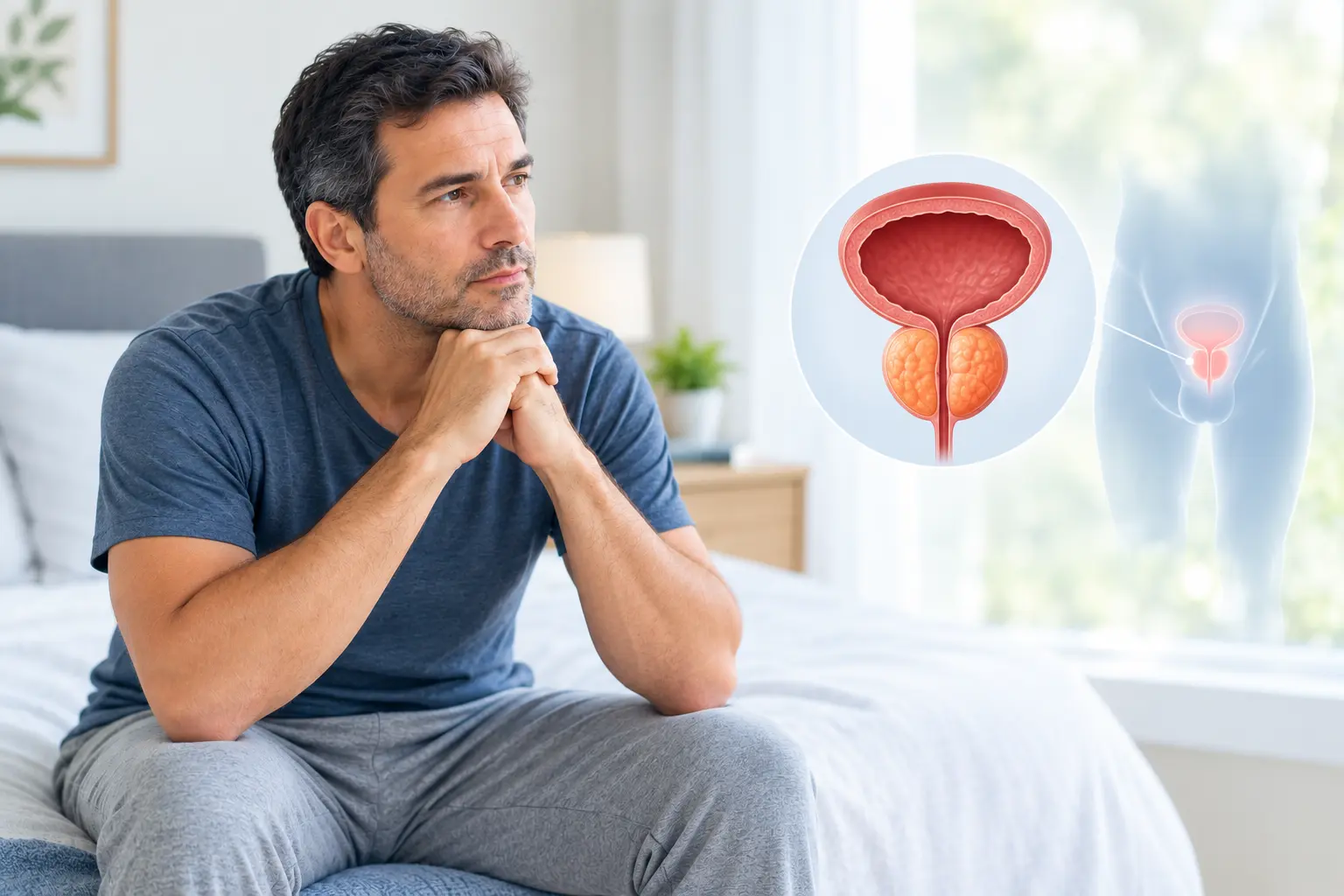
Quick answer
Sometimes, and mostly indirectly. Urology reviews find that men with moderate to severe urinary symptoms from benign prostatic hyperplasia (BPH) are more likely to report erection problems, ejaculation changes, and lower desire (Eur Urol 2005 review, Current Urology Reports 2025). Prostate size alone does not predict this (NIDDK), and several common BPH treatments carry their own sexual side effects (Flomax label, Proscar label). Many men can improve both problems with a clinician’s help.
Medical review Status: This article has not been independently reviewed by a medical professional. It was researched using publicly available scientific literature, authoritative health sources, and product information. It is for general education and is not a substitute for individualized medical advice.
Scope: This article addresses the US market. Regulatory treatment of medicines and supplements differs by country, so readers elsewhere should check their own regulator. Drug label figures below come from US prescribing information.
Can an enlarged prostate cause sexual problems?
It is associated with them, but the evidence shows a link more than a proven direct cause, and the link runs mainly through urinary symptoms rather than the size of the gland.
BPH is a non-cancerous growth of the prostate. The National Institute of Diabetes and Digestive and Kidney Diseases (NIDDK) estimates it affects 5% to 6% of men ages 40 to 64 and 29% to 33% of men 65 and older (NIDDK). A review in European Urology concluded that men with moderate to severe lower urinary tract symptoms (LUTS) are at increased risk of erectile dysfunction (ED), ejaculatory dysfunction, and low sexual desire, and that large studies showed a consistent, strong relationship between LUTS and both ED and ejaculatory problems (Eur Urol 2005 review).
A 2025 review in Current Urology Reports adds two specifics. Men with ED were 1.33 to 6.24 times more likely to have BPH than the general population, and symptom severity on the International Prostate Symptom Score (IPSS) significantly predicted every domain of the International Index of Erectile Function, including erectile function, orgasm, desire, and overall satisfaction (Current Urology Reports 2025).
Association is not causation. NIDDK lists ED, type 2 diabetes, heart and blood vessel disease, obesity, and physical inactivity among the conditions that make BPH more likely (NIDDK), which suggests shared risk factors may explain part of the overlap. The sources we retrieved do not settle how much of it is direct.
Does a bigger prostate mean worse sexual function?
Not necessarily. NIDDK states that BPH symptoms may not be directly related to prostate size: a large prostate can cause few symptoms, while a slightly enlarged one can interfere with urination considerably (NIDDK). The sexual associations reported in the research above are tied to symptom severity (Eur Urol 2005 review, Current Urology Reports 2025), so the number on an ultrasound report tells you less about your sex life than how bothersome your urinary symptoms are. That is our reading of the two sources together, not a finding either one states.
Researchers have proposed shared biology. One comprehensive review notes that the mechanisms behind ejaculatory disorders appear related to those behind ED and LUTS, and that disturbed smooth-muscle signaling through the nitric oxide and cGMP pathway could play a major role in retrograde ejaculation and anejaculation (Ejaculation and BPH review). It is a hypothesis, not an established explanation.
How can BPH change ejaculation and desire?
Ejaculatory complaints in BPH are varied. Men describe pain or discomfort at ejaculation, changes in semen quantity or quality, premature or delayed ejaculation, retrograde ejaculation (semen travels back into the bladder), or no ejaculate at all (Ejaculation and BPH review). The European Urology review also names low sexual desire as part of the picture in men with significant LUTS (Eur Urol 2005 review).
Pain, urgency, and nighttime waking can plausibly affect intimacy and mood, but the sources we retrieved do not measure that pathway directly, so treat it as a reasonable possibility rather than a finding.
Which BPH treatments affect sex?
For many men, treatment matters as much as the prostate itself. A review of LUTS therapies concluded that both medical and surgical management have side effect profiles that may affect erection, ejaculation, or libido, and that these should be discussed before choosing a treatment (LUTS treatment side-effects review).
| Treatment | What the evidence reports | Source |
|---|---|---|
| Alpha blocker (tamsulosin) | In US label trials, abnormal ejaculation (including retrograde ejaculation and ejaculation failure) occurred in 8.4% at 0.4 mg and 18.1% at 0.8 mg, versus 0.2% on placebo. No participants stopped the 0.4 mg dose because of it. | Flomax label |
| 5-alpha reductase inhibitor (finasteride) | In the first year of the label trial, impotence was 8.1% versus 3.7% on placebo, decreased libido 6.4% versus 3.4%, and ejaculation disorder 0.8% versus 0.1%. In years 2 to 4, differences from placebo were not significant. Persistent sexual dysfunction after stopping has been reported rarely. | Proscar label |
| Once-daily tadalafil 5 mg | In a 606-man placebo-controlled trial in men with both ED and BPH, the 5 mg dose significantly improved both the IPSS and the erectile function score. The 2.5 mg dose did not significantly improve the IPSS. | Tadalafil label |
| Minimally invasive procedures (Rezum, Urolift, iTind, Optilume, prostatic artery embolization) | Randomized trials reported minimal associated risk of sexual dysfunction. | Current Urology Reports 2025 |
| Aquablation versus TURP | Similar urinary improvement with significantly less ejaculatory dysfunction. | Current Urology Reports 2025 |
| Surgery to remove prostate tissue | NIDDK lists sexual problems, including ED, retrograde ejaculation, and infertility, among possible complications. | NIDDK |
Two cautions apply. First, trial rates from different drugs cannot be compared directly, a point the tamsulosin label itself makes (Flomax label). Second, the table describes groups of men. Your own risk depends on your age, health, and other medicines, which only your prescriber can weigh.
The American Urological Association’s 2026 guideline on procedural management of LUTS/BPH includes a dedicated section on sexual function to support patient counseling and procedure selection (AUA 2026 guideline). If sexual function matters to you, say so before treatment is chosen.
Do prostate supplements help sexual function in BPH?
We did not identify good evidence that they do. The most relevant high-quality review is a 2023 Cochrane analysis of 27 trials with 4,656 participants. It found that saw palmetto (Serenoa repens) alone made little to no difference in urinary symptoms or quality of life compared with placebo at three to six months, and that combinations with other herbal products also showed little to no difference, with more uncertainty (Cochrane 2023). The summary we retrieved does not report sexual function as an outcome.
Ingredient research is not product research, and a formula built around saw palmetto inherits that uncertainty. NIDDK adds that researchers have not found diet or nutrition to cause or prevent BPH, though some habits can ease symptoms, such as limiting fluids before bed and cutting back on alcohol and caffeine (NIDDK). Supplements are also not a substitute for evaluation, since urinary symptoms can come from other causes.
What should you do about it?
Tell a clinician about both sets of symptoms. NIDDK notes that urinary symptoms can also stem from bladder problems, urinary tract infections, prostatitis, or prostate cancer, so they deserve evaluation (NIDDK).
Seek care right away if you cannot urinate at all, have blood in your urine, have a fever and chills with painful, frequent urination, or feel great pain in the lower abdomen (NIDDK).
Useful questions to bring to the visit:
- Which of my symptoms is most bothersome, and could any of my current medicines be worsening it? NIDDK names decongestants, antihistamines, tranquilizers, antidepressants, and diuretics as medicines that can aggravate BPH symptoms (NIDDK).
- If I start a BPH medicine, what are the sexual side effects, and what happens if I notice them?
- Would a drug or procedure with a lower ejaculatory risk suit me (Current Urology Reports 2025)?
- Could once-daily tadalafil be appropriate, given that I have both urinary and erection symptoms (Tadalafil label)?
Do not stop a prescribed medicine on your own because of a side effect. Talk to the prescriber first. Physical activity and limiting alcohol and caffeine are low-risk steps NIDDK includes for symptom management (NIDDK).
Frequently asked questions
Can an enlarged prostate cause erectile dysfunction?
BPH and ED often occur together, and men with more severe urinary symptoms report more erection problems (Eur Urol 2005 review, Current Urology Reports 2025). Whether BPH directly causes ED is not settled, because shared conditions such as diabetes, obesity, and heart disease may contribute (NIDDK). A clinician can check for treatable contributors.
Does BPH medication always cause sexual side effects?
No. In the US label trials, most men taking finasteride did not report impotence, and rates in years 2 to 4 did not differ significantly from placebo (Proscar label). Tamsulosin is more likely to affect ejaculation than erection (Flomax label). Individual responses vary, so ask your prescriber what to watch for.
Is there a medicine for both ED and BPH symptoms?
US prescribing information for once-daily tadalafil 5 mg describes a placebo-controlled trial in men with both conditions, in which it improved urinary symptom scores and erectile function scores (Tadalafil label). Whether it suits you depends on your other medicines and health conditions, which is a prescriber decision.
References
All sources were retrieved on October 19, 2026. Where a PubMed page could not be opened directly, the abstract was read from the search result and only abstract-level details are cited.
- Sexual dysfunction and lower urinary tract symptoms (LUTS) associated with benign prostatic hyperplasia (BPH). Eur Urol. 2005;47(6):824-37. doi:10.1016/j.eururo.2004.12.013. PubMed: https://pubmed.ncbi.nlm.nih.gov/15925080/
- Benign Prostatic Hyperplasia and Sexual Dysfunction: Review of the Impact of New Medical and Surgical Therapies on Sexual Health. Current Urology Reports, 2025. doi:10.1007/s11934-025-01279-z. PubMed Central: https://pmc.ncbi.nlm.nih.gov/articles/PMC12149265/
- Ejaculations and Benign Prostatic Hyperplasia: An Impossible Compromise? A Comprehensive Review. PubMed Central: https://www.ncbi.nlm.nih.gov/pmc/articles/PMC8704358/
- Review of the common side effects of medical and surgical treatments of LUTS (keywords: alpha blockers, benign prostatic hypertrophy, erectile dysfunction, phosphodiesterase-5 inhibitors, retrograde ejaculation). PubMed, PMID 26438220: https://www.ncbi.nlm.nih.gov/pubmed/26438220
- National Institute of Diabetes and Digestive and Kidney Diseases (NIDDK), National Institutes of Health. Enlarged Prostate (Benign Prostatic Hyperplasia). https://www.niddk.nih.gov/health-information/urologic-diseases/prostate-problems/prostate-enlargement-benign-prostatic-hyperplasia
- FLOMAX (tamsulosin hydrochloride) capsules, US prescribing information, Section 6 Adverse Reactions (abnormal ejaculation table and withdrawal data). Label text reproduced at MedLibrary: https://medlibrary.org/lib/rx/meds/tamsulosin-hydrochloride-40/page/2/ ; FDA label data cross-check: https://fda.report/FDA-Labels/15c7bc4a-613f-45c2-b236-c19d90090ebe
- PROSCAR (finasteride) 5 mg, US prescribing information, Section 6 Adverse Reactions (Table 1 and postmarketing note). Label text reproduced at MedLibrary: https://medlibrary.org/lib/rx/meds/proscar/
- Tadalafil, US prescribing information, Section 14.4 “Tadalafil 5 mg for Once Daily Use for ED and BPH.” Label text reproduced at MedLibrary: https://medlibrary.org/lib/rx/meds/tadalafil-37/page/10/
- Management of Lower Urinary Tract Symptoms Attributed to Benign Prostatic Hyperplasia: AUA Guideline (2026) Part III: Procedural/Surgical Management. J Urol. 2026;216(2):161-170. doi:10.1097/JU.0000000000005099. PubMed: https://pubmed.ncbi.nlm.nih.gov/42095468/
- Serenoa repens for the treatment of lower urinary tract symptoms due to benign prostatic enlargement. Cochrane Database of Systematic Reviews, 2023, Issue 6 (CD001423). PubMed Central: https://pmc.ncbi.nlm.nih.gov/articles/PMC10286776/