Does Working Out Increase Testosterone? Short-Term Rise, Long-Term Reality

Sources Verified
Our editorial team has checked the sources referenced in this article for relevance and accuracy. This does not mean the article has been independently reviewed by a medical professional.
Does Working Out Increase Testosterone?
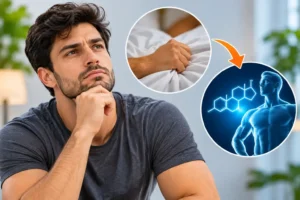
Yes, but only briefly. A single moderate or hard workout raises testosterone for roughly 30 minutes, and resistance training may keep it elevated a little longer. Regular exercise has little effect on resting testosterone in otherwise healthy men, though it may help if it leads to weight loss. Very heavy training, especially endurance training with too little food, can lower testosterone. Persistently low sex drive or fatigue deserves a doctor’s blood test.
Key takeaways
- Testosterone rises temporarily after moderate or intense exercise, but the rise fades quickly and is not the same as a lasting increase.
- Studies of regular training in healthy men find little change in resting testosterone, so exercise is not a reliable way to raise it.
- Excessive training load or too little energy intake can lower testosterone, and persistent symptoms need medical testing.
Does a single workout raise testosterone?
Yes, temporarily. A 2020 meta-analysis (D’Andrea et al., Journal of Endocrinological Investigation) pooled 48 studies and 126 trials covering 569 men with a mean age of 29.7 years. It found that physical activity acutely increased total testosterone, with a standardized mean difference of 0.74 (95% CI 0.56 to 0.91). Testosterone rose after moderate and high-intensity exercise, but not after mild activity. The increase was evident immediately and within 30 minutes of finishing, but not after 30 minutes. The authors called the effect acute and transitory.
In plain terms, a hard workout gives a short-lived bump. It does not show that a workout leaves you with more testosterone the next day.
Does the type of exercise matter?
It can change how long the rise lasts. A 2026 systematic review of 15 randomized trials with 251 participants (Tu et al., PeerJ) found that testosterone showed a greater increase after resistance training, with a delayed return to baseline, while levels typically recovered within one hour after aerobic exercise. The same review found the response was more pronounced in younger males than in older adults, with a negligible response in adolescents, and it noted that studies have reached conflicting conclusions overall.
For high-intensity interval training (HIIT), a meta-analysis (Dote-Montero et al.) found that testosterone and cortisol rose immediately after a session, then dropped below baseline, and returned to baseline after 24 hours. Cortisol is a stress hormone. That pattern suggests the body’s hormone response to hard training is temporary and swings both ways.
Does regular training raise your baseline testosterone?
Mostly no, in healthy men. A 2021 meta-analysis of 11 randomized trials covering 421 insufficiently active but otherwise healthy men found that exercise training had a negligible effect on resting total testosterone, regardless of the type of training, age group, or body weight.
In men aged 60 and older, a 2019 meta-analysis of 22 studies found that resistance training did not significantly change basal testosterone, while aerobic and interval training produced small increases. The authors described the overall effect as small and inconsistent.
So regular exercise has strong health reasons behind it, but “raising testosterone” is not a reliable one. Our guide to raising testosterone naturally covers the other factors in more detail.
Can exercise help through weight loss?
Possibly, for men with excess weight. A 2013 meta-analysis of 24 studies found that weight loss through diet or bariatric surgery was associated with higher testosterone. If exercise helps you lose excess weight, that evidence may apply to you, but the benefit would come from the weight change rather than the workouts themselves. The evidence does not show a similar gain for men already at a healthy weight.
Can working out lower testosterone?
Yes, in some situations. A 2020 review in Frontiers in Endocrinology (Hackney) explains that low energy availability or excessive training load (overtraining) can produce low testosterone in men, which appears transient and resolves with appropriate clinical intervention. A separate, more persistent pattern has been described in endurance athletes. A review by Lane and Hackney found that men chronically exposed to endurance training can show persistently reduced resting free and total testosterone without a matching rise in luteinizing hormone, the pituitary signal that normally drives testosterone production. The same review states that this appears limited to men who have trained persistently in endurance sports for an extended period, so it is not highly prevalent.
This is not a reason to avoid exercise. It means that very high training volume combined with under-eating, poor sleep, or constant fatigue is worth taking seriously. If you train heavily and notice a falling sex drive, persistent tiredness, or declining performance, see a doctor rather than training harder.
How do you know whether your testosterone is low?
Only a blood test can show it. The American Urological Association (AUA) guideline uses a total testosterone level below 300 ng/dL as a reasonable cut-off and says the diagnosis should be made only after two early-morning measurements on separate occasions, together with symptoms or signs. Because the post-exercise rise fades within about 30 minutes, ask your doctor about the best timing for a test if you train in the morning.
Conclusion
Working out raises testosterone for a short time after moderate or intense sessions, with resistance training possibly lasting a little longer. The best available evidence does not show that regular exercise reliably raises resting testosterone in healthy men, and extreme training with too little energy can lower it. The main uncertainty is that results vary with exercise type, intensity, age, and how and when testosterone is measured. Keep exercising for its other benefits, and see a doctor for testing if symptoms persist.
Statistics Ledger
| # | Statistic as written | Value | Type | Population | Data year | Publisher | Status |
|---|---|---|---|---|---|---|---|
| 1 | 48 studies, 126 trials; acute total testosterone rise after exercise | SMD 0.74 (95% CI 0.56–0.91) | Meta-analysis, standardized mean difference | 569 adult men, mean age 29.7 | 2020 | D’Andrea et al., J Endocrinol Invest | VERIFIED (abstract) |
| 2 | Rise seen within 30 minutes but not after | p < 0.001 within 30 min; p = 0.930 after | Sensitivity analysis | Same | 2020 | D’Andrea et al. | VERIFIED (abstract) |
| 3 | 15 RCTs; resistance training gives longer-lasting rise than aerobic | 15 RCTs, 251 participants | Systematic review | Mostly healthy adults | 2026 | Tu et al., PeerJ | VERIFIED (abstract) |
| 4 | HIIT: rise, dip below baseline, return by 24 h | 24 h | Meta-analysis finding | Healthy individuals | 2020 or later | Dote-Montero et al. | PARTIALLY VERIFIED (read from an excerpt of the full text; journal details not shown) |
| 5 | Exercise training in insufficiently active men: negligible effect on resting total testosterone | 11 RCTs, 421 men | Meta-analysis | Insufficiently active healthy men aged 19–75 | 2021 | Potter et al., J Strength Cond Res | PARTIALLY VERIFIED (read via a PEDro record of the abstract) |
| 6 | Men aged 60+: resistance training not significant | 22 studies | Meta-analysis | Men ≥60 years | 2019 | Hayes and Elliott, Front Physiol | VERIFIED (abstract) |
| 7 | Weight loss associated with higher testosterone | 24 studies | Meta-analysis | Men with obesity-related low testosterone | 2013 | Corona et al., Eur J Endocrinol | VERIFIED (abstract) |
| 8 | Diagnostic cut-off and two early-morning tests | 300 ng/dL; 2 tests | Guideline threshold | Adult men | 2018 (validity confirmed 2024) | AUA | VERIFIED |
Sources
- D’Andrea S, et al. Endogenous transient doping: physical exercise acutely increases testosterone levels, results from a meta-analysis. J Endocrinol Invest 2020: https://pubmed.ncbi.nlm.nih.gov/32297287/ and https://ricerca.univaq.it/handle/11697/145548
- Tu et al. Effect of acute exercise on the dynamics of testosterone levels: a systematic review of randomized controlled trials. PeerJ 2026: https://peerj.com/articles/20615
- Dote-Montero M, et al. Acute effect of HIIT on testosterone and cortisol levels in healthy individuals: a systematic review and meta-analysis: https://digibug.ugr.es/bitstream/handle/10481/69501/sms.13999.pdf?sequence=1
- Potter NJ, et al. Effects of exercise training on resting testosterone concentrations in insufficiently active men. J Strength Cond Res 2021: https://search.pedro.org.au/search-results/record-detail/69401
- Hayes LD, Elliott BT. Short-term exercise training inconsistently influences basal testosterone in older men. Front Physiol 2019: https://pubmed.ncbi.nlm.nih.gov/30692929/
- Corona G, et al. Body weight loss reverses obesity-associated hypogonadotropic hypogonadism: a systematic review and meta-analysis. Eur J Endocrinol 2013: https://pubmed.ncbi.nlm.nih.gov/23482592/
- Hackney AC. Hypogonadism in exercising males: dysfunction or adaptive-regulatory adjustment? Front Endocrinol 2020: https://frontiersin.org/articles/10.3389/fendo.2020.00011/full
- Lane AR, Hackney AC. Reproductive dysfunction from the stress of exercise training is not gender specific: the “exercise-hypogonadal male condition”: https://pmc.ncbi.nlm.nih.gov/articles/PMC5897104.
- American Urological Association. Evaluation and Management of Testosterone Deficiency (Mulhall et al., J Urol 2018; validity confirmed 2024): https://www.auanet.org/guidelines-and-quality/guidelines/testosterone-deficiency-guideline
Medical Disclaimer
The information provided in this article is for educational and informational purposes only. It is not intended to diagnose, treat, cure, or prevent any disease or medical condition.
This content should not be considered a substitute for professional medical advice, diagnosis, or treatment. Always consult a qualified healthcare professional before making decisions about your health, medications, or supplements.
Do not disregard professional medical advice or delay seeking it because of information published on this website.