
Worst Foods for Prostate Health: What the Research Says
Sources Verified
Our editorial team has checked the sources referenced in this article for relevance and accuracy. This does not mean the article has been independently reviewed by a medical professional.
Ten Worst Foods for Prostate Health
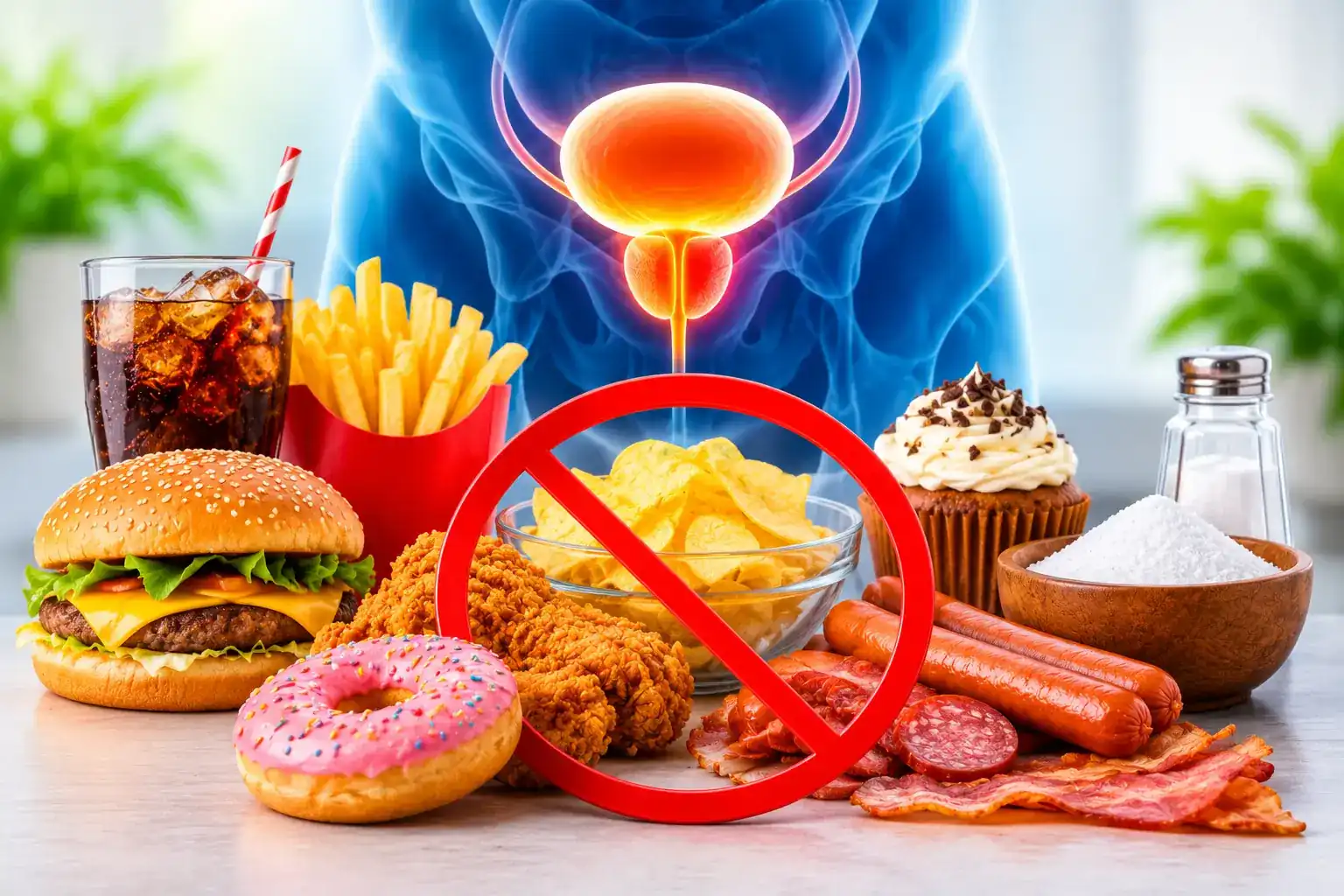
No food has been proven to damage the prostate. Research links a few foods and drinks, including red and processed meat, fatty foods, dairy, caffeine, and alcohol, to prostate cancer or enlarged-prostate symptoms, but the evidence is mostly observational and mixed. Cancer Research UK says it is unclear whether particular foods change prostate cancer risk. Persistent urinary symptoms should be checked by a doctor, not managed by diet alone.
Key takeaways
- Most links between single foods and prostate problems are modest and come from observational studies, which cannot prove that a food caused the problem.
- The strongest signals concern enlarged-prostate symptoms (red meat, fatty foods, caffeine, evening fluids) more than prostate cancer.
- Overall diet, body weight, and vegetables matter more than avoiding any one food, and persistent urinary symptoms need a medical check.
How strong is the evidence?
Prostate cancer and BPH are different conditions, and diet studies rarely treat them the same way. A UK analysis of food diaries from several cohorts found no strong associations between prostate cancer risk and 37 dietary factors (UK Dietary Cohort Consortium, European Journal of Clinical Nutrition, 2016). For urinary symptoms, a systematic review of 111 articles (Bradley et al., Journal of Urology, 2017) found that the evidence grade was generally low and associations with specific foods were inconsistent. Keep those limits in mind for every item below.
1. Red meat
Evidence: supported for BPH risk (observational); uncertain for prostate cancer.
In the Prostate Cancer Prevention Trial, which followed 4,770 men without BPH, daily red meat eaters had a 38% higher hazard of symptomatic BPH than men eating it less than once a week (Thompson et al., American Journal of Epidemiology, 2008). For prostate cancer, a meta-analysis of 15 prospective studies found no association between red meat intake and total prostate cancer (Alexander et al.). A pooled analysis of 15 cohorts found only marginally significant, modestly higher risks of advanced prostate cancer.
2. Processed meat
Evidence: uncertain.
Processed meat shows a slightly firmer signal than red meat, but it is weak. The Alexander meta-analysis found a weakly elevated association with total prostate cancer, along with evidence of publication bias. The World Cancer Research Fund (WCRF) pooled analysis concluded that of the meat groups examined, there was suggestive evidence of an association only for processed meat. Processed meat has stronger evidence for other cancers, which is a separate reason to limit it.
3. High-fat foods
Evidence: uncertain to supported for BPH.
In the same Prostate Cancer Prevention Trial analysis, men in the highest quintile of total fat intake had a 31% higher hazard of BPH than those in the lowest quintile. Mayo Clinic advises that a low-fat diet and a variety of vegetables may lessen BPH symptoms. The evidence is not uniform: a 2012 review described polyunsaturated fat as lowering risk, while the trial above found it raised risk. Fat type matters, and that is unresolved.
4. Dairy foods
Evidence: uncertain.
In the European EPIC cohort of 142,251 men, a 35 g per day increase in dairy protein was associated with a 32% higher prostate cancer risk (95% CI 1% to 72%) (Allen et al., British Journal of Cancer, 2008). A narrative review of articles from 2015 to 2024 reported an overall positive association between dairy and prostate cancer, but not strong enough evidence to limit dairy intake in the whole population. Dairy is also a main source of calcium, so cutting it out has its own costs.
5. High-dose calcium supplements
Evidence: uncertain.
The WCRF’s 2007 report concluded that diets high in calcium probably increase prostate cancer risk, but the evidence has since been described as limited. A later pooled analysis found calcium intake associated with a slightly higher risk of total prostate cancer, with no significant associations for specific subtypes. Cancer Research UK notes that adults need 700 mg of calcium a day, which most people can get from a balanced diet. Do not stop calcium that a doctor prescribed for bone health without asking first.
6. Coffee and other caffeinated drinks
Evidence: supported for urinary urgency and frequency; not shown to cause BPH or cancer.
The 2017 systematic review found fluid and caffeine intake were associated with urinary frequency and urgency in men and women. Mayo Clinic advises limiting caffeine because it may stimulate the urge to urinate. This is about bladder irritation and symptoms, not about harming the prostate itself.
7. Alcohol
Evidence: mixed.
Alcohol is not clearly harmful for BPH. The systematic review found modest alcohol intake associated with a lower likelihood of a BPH diagnosis and fewer urinary symptoms in men, and the Prostate Cancer Prevention Trial reported a lower risk in men with two or more drinks a day than in non-drinkers. Mayo Clinic still suggests limiting alcohol because it may stimulate the urge to urinate. This article does not assess alcohol and prostate cancer risk, and these findings are not a reason to start drinking.
8. Large drinks in the evening
Evidence: supported for night-time urinary symptoms (a habit, not a food).
Mayo Clinic advises avoiding liquids a few hours before bedtime or before going out. It matches the review finding that fluid intake relates to urinary frequency and urgency.
9. Starchy foods
Evidence: under study.
A 2012 review in Current Opinion in Urology noted that dietary patterns associated with increased BPH risk include starches and red meats. The abstract is too brief to name a risky starch, so this is a research direction, not a reason to cut out bread, rice, or potatoes.
10. Foods that add excess weight
Evidence: uncertain, through body weight.
Obesity has been linked to BPH and urinary symptoms: a clinician-facing nutrition guide cites a 2012 study (Lee et al., BJU International) finding that central obesity, measured by waist circumference, predicted more severe urinary symptoms. Mayo Clinic’s advice includes regular exercise and watching your waistline. The link runs through overall calories and weight, not one particular food.
What does the evidence say may help?
The best-supported pattern is a plain one. In the Prostate Cancer Prevention Trial, men eating four or more servings of vegetables a day had a 32% lower hazard of symptomatic BPH than those eating less than one. Cancer Research UK says that tomatoes and other fruit and vegetables can be part of a healthy balanced diet that helps reduce cancer risk overall, though there is no good evidence that lycopene in particular lowers prostate cancer risk.
When should you see a doctor?
See a doctor about persistent urinary symptoms, such as frequent or urgent urination, a weak stream, or waking often at night. These symptoms have several possible causes, and diet changes should not delay a medical check. Mayo Clinic describes diet and exercise changes as ways to help manage BPH symptoms, not as treatment. If you take prescribed medication for a prostate condition, do not change it because of an article.
Conclusion
Research links several foods and drinks, mainly red meat, fatty foods, and caffeine, to enlarged-prostate symptoms, and links dairy, calcium, and processed meat to prostate cancer with much weaker and less consistent evidence. The main uncertainty is that most studies are observational, so they cannot show that a food caused the problem. A balanced diet rich in vegetables, a healthy weight, and prompt medical attention for symptoms are better-supported than avoiding any single food.
Statistics Ledger
| # | Statistic as written | Value | Type | Population | Data year | Publisher | Status |
|---|---|---|---|---|---|---|---|
| 1 | Daily red meat vs less than weekly: higher BPH hazard | HR 1.38 | Hazard ratio, observational | 4,770 men without BPH at baseline (876 incident cases) | 2008 publication (trial 1994–2003) | Thompson et al., Am J Epidemiol | VERIFIED (abstract) |
| 2 | Highest vs lowest quintile of total fat: higher BPH hazard | 31% | Relative risk, observational | Same cohort | 2008 | Thompson et al. | VERIFIED (abstract) |
| 3 | Four or more vegetable servings a day vs under one: lower BPH hazard | HR 0.68 (32% lower) | Relative risk, observational | Same cohort | 2008 | Thompson et al. | VERIFIED (abstract) |
| 4 | Two or more alcoholic drinks a day vs none: lower BPH hazard | HR 0.67 | Relative risk, observational | Same cohort | 2008 | Thompson et al. | VERIFIED (abstract) |
| 5 | Red meat and total prostate cancer: no association | SRRE 1.00 (0.96–1.05) | Meta-analysis of 15 prospective studies | Men in prospective cohorts | Not shown in opened text | Alexander et al. | PARTIALLY VERIFIED (publication year not shown in opened pages) |
| 6 | 35 g/day increase in dairy protein: higher prostate cancer risk | 32% (95% CI 1–72%) | Relative risk, observational | 142,251 men, EPIC cohort | 2008 | Allen et al., Br J Cancer | VERIFIED |
| 7 | No strong associations between prostate cancer and 37 dietary factors | 37 factors | Cohort analysis of food diaries | Middle-aged and older UK men | 2016 | UK Dietary Cohort Consortium, Eur J Clin Nutr | VERIFIED (abstract) |
| 8 | 111 articles; evidence grade generally low | 111 articles | Systematic review | Men and women with urinary symptoms | 2017 | Bradley et al., J Urol | VERIFIED (abstract) |
| 9 | Adults need 700 mg calcium a day | 700 mg/day | Guidance value | UK adults | Page accessed 2025 per its references | Cancer Research UK | PARTIALLY VERIFIED (read on an internal-host URL; check the public page) |
| 10 | WCRF pooled analysis of 15 cohorts: marginally higher advanced prostate cancer risk with red and processed meat | 15 cohorts | Pooled cohort analysis | Men in the Pooling Project | Not shown in open text | WCRF-funded study | PARTIALLY VERIFIED (data year not shown) |
Sources
- Thompson IM, et al. Dietary patterns, supplement use, and the risk of symptomatic benign prostatic hyperplasia: results from the Prostate Cancer Prevention Trial. Am J Epidemiol 2008: https://academic.oup.com/aje/article/167/8/925/77073
- Bradley CS, et al. Evidence of the impact of diet, fluid intake, caffeine, alcohol and tobacco on lower urinary tract symptoms: a systematic review. J Urol 2017: https://pubmed.ncbi.nlm.nih.gov/28479236/
- Allen NE, et al. Animal foods, protein, calcium and prostate cancer risk: the European Prospective Investigation into Cancer and Nutrition. Br J Cancer 2008: https://opus.bibliothek.uni-augsburg.de/opus4/files/85177/6604331.pdf
- Prostate cancer risk related to foods, food groups, macronutrients and micronutrients derived from the UK Dietary Cohort Consortium food diaries. Eur J Clin Nutr 2016: https://www.ncbi.nlm.nih.gov/pmc/articles/PMC5215092/
- Alexander DD, et al. A review and meta-analysis of prospective studies of red and processed meat intake and prostate cancer: https://pmc.ncbi.nlm.nih.gov/articles/PMC2987772 (news summary: https://www.foodnavigator.com/Science-Nutrition/No-red-or-processed-meat-link-to-prostate-cancer-Meta-analysis)
- World Cancer Research Fund. Pooled analysis of meat intake and prostate cancer: https://www.wcrf.org/?p=4722
- World Cancer Research Fund. Dairy and plant foods, and advanced prostate cancer: https://wcrf.org/int/research-we-fund/what-we-re-funding/dairy-and-plant-foods-and-advanced-prostate-cancer
- Cancer Research UK. Food controversies and supplements (prostate cancer): https://main.int.cruk.org/about-cancer/prostate-cancer/practical-emotional-support/food-controversies-supplements
- Mayo Clinic. Can diet help with symptoms of an enlarged prostate?: https://mayoclinic.org/diseases-conditions/benign-prostatic-hyperplasia/expert-answers/enlarged-prostate-and-diet/faq-20322773
- Espinosa G. Nutrition and benign prostatic hyperplasia. Curr Opin Urol 2012 (abstract): https://b2b.sigmaaldrich.com/US/en/tech-docs/paper/300994
- Narrative review of dairy and prostate cancer (articles 2015–2024), Oxford University Research Archive: https://ora.ox.ac.uk/objects/uuid:a1689430-fbff-4bd8-af57-a1c49ee36ced
- Physicians Committee for Responsible Medicine. Nutrition guide for clinicians: benign prostatic hyperplasia (cites Lee et al., BJU Int 2012): https://nutritionguide.pcrm.org/nutritionguide/view/Nutrition_Guide_for_Clinicians/1342049/1/pramanifest
Medical Disclaimer
The information provided in this article is for educational and informational purposes only. It is not intended to diagnose, treat, cure, or prevent any disease or medical condition.
This content should not be considered a substitute for professional medical advice, diagnosis, or treatment. Always consult a qualified healthcare professional before making decisions about your health, medications, or supplements.
Do not disregard professional medical advice or delay seeking it because of information published on this website.