Is Sleep Apnea Considered a Disability? Look at Your Rights and Options
Sleep apnea is one of the conditions that many people don’t realize they have. Your breathing will start and stop over and over while you sleep. You may feel tired after waking up, even completely after a full night of sleep, and spend years wondering why. Once you are diagnosed, it’s normal to have a lot of questions. One of the most common questions is, Is sleep apnea a disability?, and Can Sleep Apnea Kill You? Here are the complete answers.
People ask this question for different reasons. Some find it hard to keep up with their job because of constant fatigue. Others struggle with everyday activities as their symptoms become more severe. Some want to know if they qualify for disability benefits or workplace accommodations.
The question is common, but the answer is different for each person. It depends on how much sleep apnea affects your daily life and your ability to work.
This article explains how sleep apnea affects your body, when it may be considered a disability, and what factors determine whether you qualify for workplace accommodations or disability benefits.
How Sleep Apnea Affects the Body
Sleep Apnea is a sleep disorder; it causes your breathing to start and stop repeatedly when you sleep. These pauses can happen for a few seconds or even more longer, and may happen several times within an hour. Each time your breathing stops, your body is briefly pulled out of deep sleep, even if you don’t fully wake up.
The most common type is obstructive sleep apnea (OSA). It happens when the muscles in the back of the throat relax too much, blocking the airway. A less common type, central sleep apnea (CSA), occurs when the brain doesn’t send the proper signals to the muscles that control breathing. Some people have a combination of both types.
The effects go far beyond feeling sleepy during the day. Because your body gets less oxygen during the night, untreated sleep apnea can put extra stress on your heart and blood vessels. Over time, it increases the risk of high blood pressure, heart disease, stroke, and type 2 diabetes.
Sleep apnea can also affect how your brain works. Many people feel poor concentration, memory problems, slower thinking, and mood swings because they aren’t getting enough quality sleep.
If you already have another health condition, sleep apnea can make it harder to manage. Conditions such as heart disease, type 2 diabetes, and depression often become more difficult to control when sleep apnea is left untreated.
Is Sleep Apnea Considered a Disability?
There isn’t a simple yes or no answer. Whether sleep apnea is considered a disability depends on the situation and the laws that apply. In some cases, it may qualify. In others, it may not.
Under the Americans with Disabilities Act (ADA)
The Americans with Disabilities Act (ADA) protects people who have a physical or mental condition that significantly limits one or more major life activities. These activities include sleeping, breathing, concentrating, working, and other everyday tasks.
Sleep apnea may qualify as a disability under the ADA if it seriously affects your ability to sleep, breathe, stay alert, or perform your job. If your symptoms make it difficult to carry out normal daily activities, you may be eligible for reasonable workplace accommodations.
However, not everyone with sleep apnea automatically qualifies. The severity of the condition matters. Mild sleep apnea that is well controlled with treatment and causes few daily problems may not meet the ADA’s definition of a disability. On the other hand, moderate or severe sleep apnea that continues to cause significant symptoms or limits your daily functioning is more likely to qualify, especially if your healthcare provider has documented those limitations.
It’s important to understand that the ADA does not automatically classify everyone with sleep apnea as having a disability. Each case is evaluated based on how the condition affects that person’s daily life and ability to work.
For example, someone with sleep apnea may qualify for reasonable accommodations at work but still not be eligible for government disability benefits. That’s because workplace protections and disability benefit programs follow different rules and have different eligibility requirements.
If you qualify under the ADA, you can ask your employer for reasonable accommodations that help you perform your job. Depending on your symptoms and job duties, these may include a later start time, a more flexible work schedule, a quieter workspace, or time to manage your treatment, such as using a CPAP machine when appropriate.
Employers are not required to approve every request. However, they are generally expected to discuss possible accommodations with you and consider options that allow you to do your job without creating significant difficulty or expense for the business.
Social Security Disability Benefits (SSDI and SSI)
Qualifying for Social Security Disability Insurance (SSDI) or Supplemental Security Income (SSI) is usually more difficult than qualifying for workplace accommodations under the ADA.
The Social Security Administration (SSA) only approves disability benefits if a medical condition prevents you from working and is expected to last at least 12 months or result in death.
Sleep apnea is not listed as a standalone condition in the SSA’s official Blue Book of impairments. However, that does not mean you cannot qualify for benefits. Instead, the SSA looks at how your sleep apnea—and any related health problems—affect your ability to work.
For many people, the biggest challenges are not just the breathing pauses during sleep but the ongoing effects they cause. Severe daytime fatigue, difficulty concentrating, memory problems, heart disease, high blood pressure, or other complications can make it difficult to perform a full-time job. The SSA considers all of these limitations when reviewing a claim.
As part of the evaluation, the SSA assesses your Residual Functional Capacity (RFC). This is an assessment of what types of work you can still do despite your medical condition and its symptoms.
It’s also common for disability claims to be denied the first time they are submitted. Many people who are eventually approved receive benefits only after filing an appeal.
Strong medical evidence can make a significant difference. Helpful documentation includes:
- Results from a sleep study confirming the diagnosis.
- Medical records showing ongoing treatment, such as CPAP therapy.
- Evidence that symptoms continue despite following treatment.
- Records of related health conditions or complications.
- Statements from your healthcare providers explaining how sleep apnea affects your ability to work and carry out daily activities.
Veterans Affairs (VA) Disability Benefits
For military veterans, the rules are different. The U.S. Department of Veterans Affairs (VA) recognizes sleep apnea as a condition that may qualify for disability compensation if it is connected to military service.
The VA uses Diagnostic Code 6847 to evaluate sleep apnea and assigns a disability rating based on how severe the condition is and the treatment required.
Current VA disability ratings include:
- 0%: Sleep apnea is diagnosed but does not cause symptoms that qualify for compensation.
- 30%: Persistent daytime sleepiness (hypersomnolence) despite getting enough sleep.
- 50%: The condition requires treatment with a CPAP machine or another approved breathing assistance device.
- 100%: Sleep apnea has caused serious complications, such as chronic respiratory failure with cor pulmonale (right-sided heart failure), or requires a tracheostomy to keep the airway open.
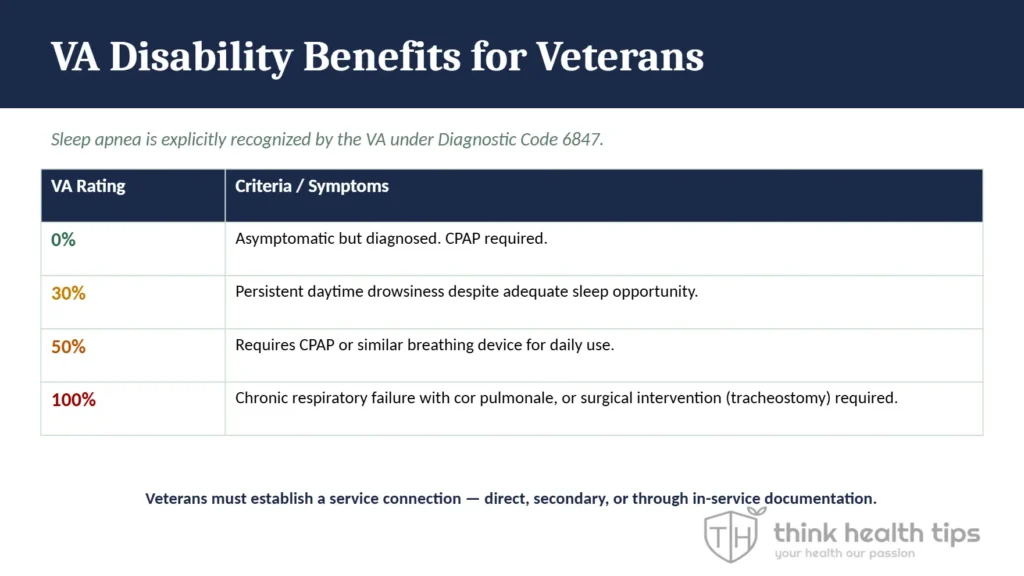
To receive VA disability benefits, veterans must also show that their sleep apnea is connected to their military service. This connection may be established in several ways, including:
- The condition began during active military service.
- Sleep apnea developed as a result of another service-connected disability (known as a secondary service connection).
- Military or medical records document symptoms or events during service that support the diagnosis.
Medical records, sleep study results, and a clear link between military service and the condition are often important pieces of evidence when filing a VA disability claim.
How Severe Does Sleep Apnea Have to Be?
Not everyone with sleep apnea qualifies as having a disability. The severity of the condition and how much it affects your daily life both play an important role.
Doctors measure the severity of sleep apnea using the Apnea-Hypopnea Index (AHI). This score shows how many times your breathing slows down or stops during each hour of sleep.
- Mild: 5–14 breathing interruptions per hour
- Moderate: 15–29 breathing interruptions per hour
- Severe: 30 or more breathing interruptions per hour
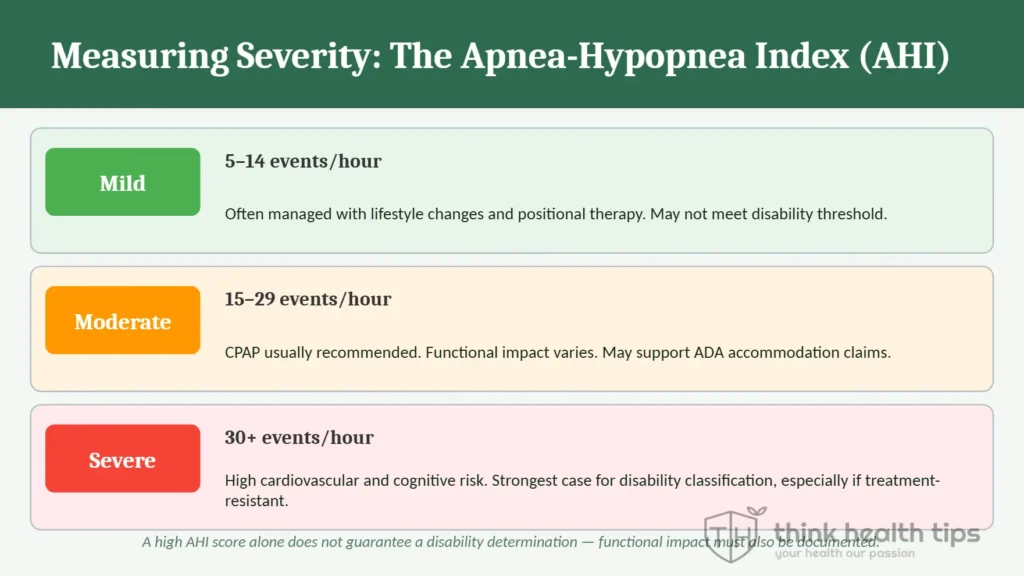
However, an AHI score alone does not determine whether you qualify for disability benefits or legal protections.
Organizations such as the Social Security Administration (SSA), the Department of Veterans Affairs (VA), or an employer evaluating an ADA accommodation request also consider how sleep apnea affects your everyday life. They may look at whether the condition causes ongoing fatigue, difficulty concentrating, reduced work performance, safety concerns, or other limitations that make it hard to perform daily activities or maintain employment.
In other words, the diagnosis is only one part of the picture. The overall impact of sleep apnea on your health, ability to work, and quality of life is often the most important factor when determining whether it qualifies as a disability.
What Documentation Do You Need?
If you’re applying for disability benefits or requesting workplace accommodations because of sleep apnea, having the right medical records is essential. Without clear documentation, it can be difficult to show how the condition affects your health and daily life.
The most important piece of evidence is a sleep study, also known as polysomnography. This test measures your breathing, oxygen levels, brain activity, heart rate, and body movements while you sleep. It confirms the diagnosis and determines the severity of your sleep apnea by calculating your Apnea-Hypopnea Index (AHI).
You should also keep records of:
- Your treatment history, including CPAP or other prescribed therapies and records showing you use the treatment as directed.
- Doctor’s notes describing your symptoms, diagnosis, and how sleep apnea affects your daily activities or ability to work.
- Hospital visits or appointments with sleep specialists and other healthcare providers.
- Medical records for related conditions, such as high blood pressure, heart disease, stroke, diabetes, or depression.
- Employment records that show missed work, reduced job performance, or requests for workplace accommodations, if applicable.
If you’re applying for VA disability benefits, additional evidence may be helpful. Military service records, medical records from your time in service, or documentation linking your sleep apnea to a service-connected condition can strengthen your claim.
The more complete and consistent your documentation is, the easier it is for employers or benefit programs to understand how sleep apnea affects your ability to work and carry out everyday activities.
Can Sleep Apnea Be Treated? Does Treatment Affect Disability Status?
Yes. Sleep apnea can often be managed with treatment, and many people experience significant improvement in their symptoms. The right treatment depends on the type and severity of sleep apnea, as well as your overall health.
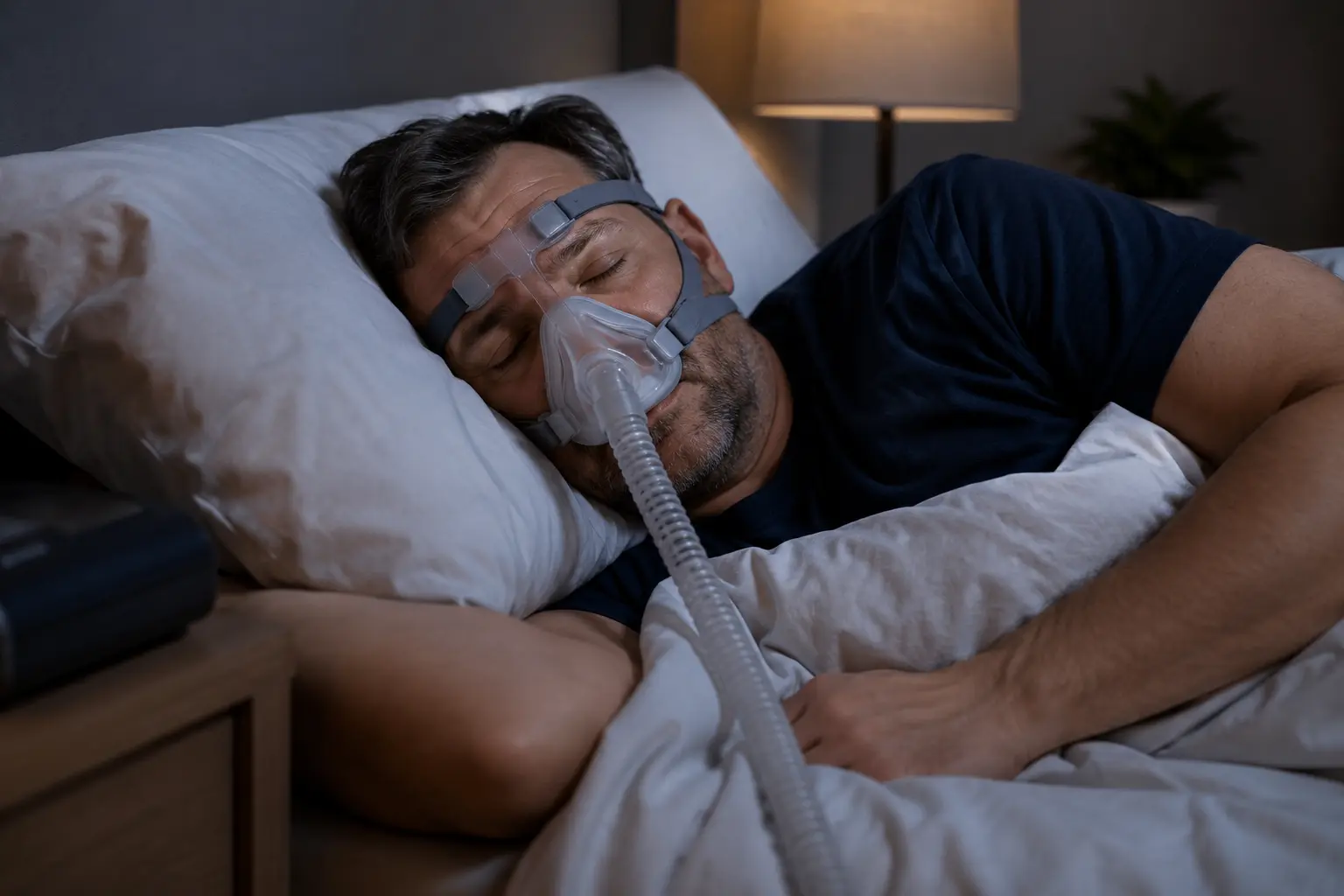
The most common treatment is Continuous Positive Airway Pressure (CPAP) therapy. A CPAP machine delivers a steady flow of air through a mask to keep your airway open while you sleep. For many people, regular CPAP use improves sleep quality, reduces daytime fatigue, and lowers the risk of long-term health complications.
Other treatment options include:
- BiPAP (Bilevel Positive Airway Pressure): Uses different air pressure levels for breathing in and out. It may be recommended for some people with central sleep apnea or for those who cannot tolerate CPAP.
- Oral appliances: Custom-made devices that move the lower jaw forward to help keep the airway open. These are often used for mild to moderate obstructive sleep apnea.
- Surgery: In some cases, surgery may help by removing or repositioning tissue that blocks the airway. Rarely, a tracheostomy may be needed for severe, life-threatening cases.
- Positional therapy: Some people have fewer breathing interruptions when they avoid sleeping on their back.
- Weight management: If excess body weight contributes to airway blockage, losing weight may reduce the severity of sleep apnea and improve symptoms.
Does Treatment Affect Disability Benefits?
Yes. Whether your symptoms improve with treatment can play an important role in disability decisions.
Programs such as the Social Security Administration (SSA) generally consider whether a medical condition can be effectively managed with appropriate treatment. If CPAP or another treatment controls your symptoms and allows you to work and perform daily activities without significant limitations, qualifying for disability benefits may be more difficult.
However, treatment does not work the same way for everyone. Some people cannot tolerate CPAP, while others continue to experience severe fatigue, poor concentration, or other symptoms despite following their treatment plan. In these situations, especially when sleep apnea is accompanied by other serious medical conditions, the condition may still meet the requirements for disability benefits or workplace accommodations.
The key factor is not simply having a diagnosis of sleep apnea, but how much the condition continues to limit your daily life and ability to work despite appropriate treatment.
Common Myths Worth Addressing
Sleep apnea is just snoring. Snoring is a symptom, not the condition itself. Plenty of people snore without sleep apnea, and some people with sleep apnea do not snore much at all. The defining feature is breathing interruption, not noise level.
“Only overweight people get sleep apnea.” Body weight is a risk factor, but sleep apnea affects people across body types. Anatomy plays a significant role, including the shape of the jaw, neck circumference, and nasal structure. Thin people can have severe sleep apnea.
If I just sleep more, I’ll feel better.” More hours in bed does not resolve the problem if breathing disruptions are pulling the body out of deep sleep. The issue is quality, not quantity.
CPAP always fixes it.” CPAP is effective for many people, but adherence is a significant challenge. Studies show that a substantial portion of users do not use the device consistently enough for full benefit. Mask discomfort, pressure intolerance, and other issues lead many people to stop using the device altogether.
You can tell if someone has sleep apnea by how tired they look.” Fatigue shows up in many ways, and many people with significant sleep apnea continue functioning for years without a diagnosis. Symptoms are often attributed to stress, aging, or other causes.
Lifestyle Factors That Affect Severity
While sleep apnea has structural causes that lifestyle cannot fix on its own, certain habits can worsen or improve symptom control.
Alcohol relaxes the muscles of the throat and is known to worsen obstructive sleep apnea, sometimes dramatically. Even moderate alcohol use in the hours before bed can increase apnea frequency.
Smoking causes inflammation and fluid retention in the airway, which raises apnea risk and severity. People who smoke have a higher prevalence of sleep apnea compared to nonsmokers.
Sleep position matters for some people. Sleeping on the back allows the tongue and soft tissues to fall backward and obstruct the airway more. Some people find that side sleeping reduces the number of apnea events significantly.
Managing other conditions, including nasal congestion and allergies, can reduce upper airway resistance and make breathing easier during sleep.
When to See a Doctor About This
Some symptoms are worth getting evaluated without waiting. These include:
- Waking up with headaches most mornings
- Waking up gasping, choking, or with a dry mouth
- A bed partner reporting that you stop breathing during sleep
- Excessive daytime sleepiness that interferes with work or driving
- Difficulty concentrating or memory problems that are getting worse
- Mood swings, including irritability or low mood, with no clear explanation
Sleep matters. It is not a luxury function the body can do without. If these symptoms sound familiar, a conversation with a physician can open the door to diagnosis and relief.
Do you want more information about Sleep? Check Sleep health for complete information.
References
American Academy of Sleep Medicine. (2014). International Classification of Sleep Disorders, 3rd edition. AASM.
U.S. Equal Employment Opportunity Commission. (2008). ADA Amendments Act of 2008. https://www.eeoc.gov/statutes/ada-amendments-act-2008
Social Security Administration. (2023). Disability Evaluation Under Social Security: Listing of Impairments. https://www.ssa.gov/disability/professionals/bluebook/
U.S. Department of Veterans Affairs. (2023). Schedule for Rating Disabilities, Diagnostic Code 6847. https://www.va.gov/disability/
Mayo Clinic Staff. (2023). Sleep apnea: Symptoms and causes. Mayo Clinic. https://www.mayoclinic.org/diseases-conditions/sleep-apnea
Peppard, P. E., Young, T., Barnet, J. H., et al. (2013). Increased prevalence of sleep-disordered breathing in adults. American Journal of Epidemiology, 177(9), 1006-1014. https://pubmed.ncbi.nlm.nih.gov/23589584/
Javaheri, S., & Dempsey, J. A. (2013). Central sleep apnea. Comprehensive Physiology, 3(1), 141-163. https://pubmed.ncbi.nlm.nih.gov/23720284/
Lévy, P., Kohler, M., McNicholas, W. T., et al. (2015). Obstructive sleep apnoea syndrome. Nature Reviews Disease Primers, 1, 15015. https://pubmed.ncbi.nlm.nih.gov/27188535/
National Heart, Lung, and Blood Institute. (2022). Sleep apnea. NIH. https://www.nhlbi.nih.gov/health/sleep-apnea
Epstein, L. J., Kristo, D., Strollo, P. J., et al. (2009). Clinical guideline for the evaluation, management and long-term care of obstructive sleep apnea in adults. Journal of Clinical Sleep Medicine, 5(3), 263-276. https://pubmed.ncbi.nlm.nih.gov/19960649/
Ramar, K., & Guilleminault, C. (2012). Treatment of obstructive and central sleep apnea. Neurologic Clinics, 30(4), 1261-1276. https://pubmed.ncbi.nlm.nih.gov/23099143/
Cleveland Clinic. (2022). Obstructive sleep apnea. https://my.clevelandclinic.org/health/diseases/8460-obstructive-sleep-apnea
Harvard Medical School, Division of Sleep Medicine. (2020). Sleep apnea and heart disease. Harvard Health Publishing. https://www.health.harvard.edu/heart-health/sleep-apnea-heart-disease-link