ProDentim vs BioDentex: Ingredients, Evidence, and Safety
Medical Review Status: This article was written by Shafeek. This article is based on published research and official guidance, and has not been medically reviewed.
ProDentim is sold as a live-probiotic chewable, while BioDentex is sold as a plant-based capsule built around xylitol. Our search found no published trial of either finished product, so neither is proven to treat gum disease or cavities. People with weakened immune systems should ask a clinician before using any probiotic, and neither product replaces brushing, flossing, and dental visits.
Key takeaways
- ProDentim and BioDentex rest on different ideas: live probiotic bacteria in ProDentim, and plant-based ingredients such as xylitol in BioDentex.
- Research on probiotics shows modest benefits, mostly when they are added to professional gum treatment; the xylitol evidence is mostly low quality, and we found no published trial of either finished product.
- People with weakened immune systems, and anyone considering a supplement during pregnancy or for a child, should ask a clinician or dentist first.
What are ProDentim and BioDentex?
Affiliate Disclosure: ThinkHealthTips may earn a commission if you buy through links on this site. This does not change how the evidence is described.
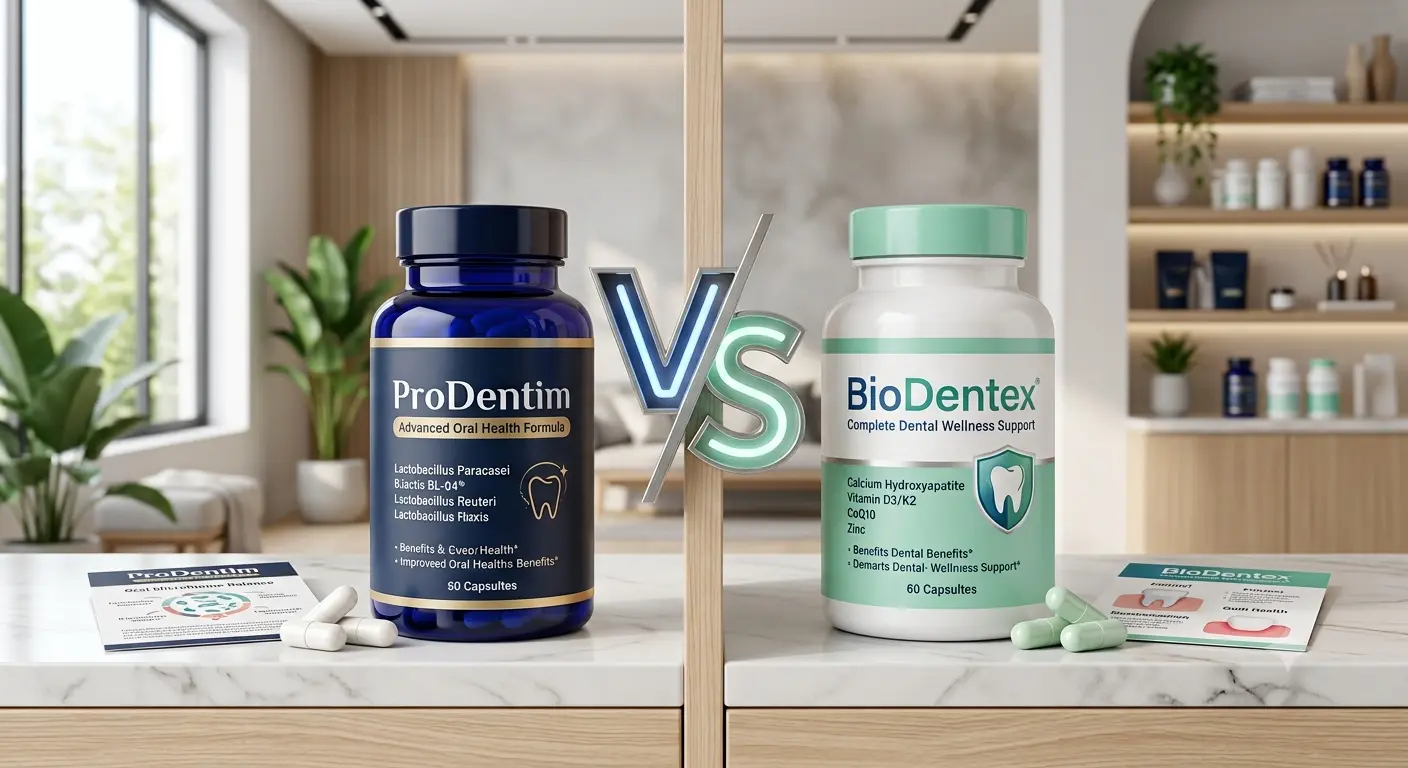
Both products are marketed for teeth, gums, and fresh breath. Both are dietary supplements that you swallow or chew, not toothpaste or mouthwash. They are built on very different ideas, which is why a side-by-side look is useful.
ProDentim is sold as a chewable oral probiotic. Third-party descriptions of its label name three bacteria as the main strains: Lactobacillus paracasei, Lactobacillus reuteri, and Bifidobacterium lactis BL-04. Those descriptions list a total of 3.5 billion colony-forming units (CFU, a count of live bacteria) per serving, along with inulin, malic acid, tricalcium phosphate, and peppermint. Some listings name additional strains, so check the Supplement Facts panel on the product you receive. Our full write-up is in our ProDentim review.
BioDentex is sold as a plant-based capsule. Most descriptions center on xylitol, stevia, carrot powder, grape seed extract, peppermint, and cranberry. One thing is unusual: our search found many separate websites, each calling itself official, and they describe the product differently. One says the formula has seven ingredients, others say 11 or more, and at least one describes probiotics and tricalcium phosphate that other listings do not mention. Read the label on the bottle you buy rather than a sales page. Our full write-up is in our BioDentex review.
ProDentim vs BioDentex at a glance
| Feature | ProDentim | BioDentex |
|---|---|---|
| Marketed as | Oral probiotic | Natural oral health formula |
| Form (as described) | Chewable tablet | Capsule |
| Core idea | Add live bacteria to the mouth | Plant-based ingredients and a sugar alcohol (xylitol) |
| Main ingredients (as described) | Three probiotic strains, inulin, malic acid, tricalcium phosphate, peppermint | Xylitol, stevia, carrot powder, grape seed extract, peppermint, cranberry |
| Live bacteria | Yes | Not in most descriptions; listings disagree |
| Published trial of the finished product | None found in our search | None found in our search |
| Main safety point | Probiotic caution for weakened immune systems | Xylitol can upset the stomach in some people |
| Price and guarantee | Check the seller page; terms change | Check the seller page; terms change |
How we compare these supplements
We set ProDentim’s probiotic approach against BioDentex’s plant-based one, comparing ingredients, evidence, and safety. Research claims rest on systematic reviews and meta-analyses. Label details are third-party descriptions because no manufacturer panel could be opened, and BioDentex listings conflict. We did not test either product. Read our supplement review methodology for the full process.
How do the ingredients compare?
The table below lists what each seller says an ingredient does, and what research we found. Where the last column says not reviewed, this article did not find or open systematic-review evidence for that ingredient in oral health.
| Ingredient | Found in | What sellers say it does | What research we found |
|---|---|---|---|
| Probiotic strains (L. paracasei, L. reuteri, B. lactis BL-04) | ProDentim | Balance mouth bacteria, support gums | Mixed. See the probiotics section below |
| Inulin | ProDentim | Feeds friendly bacteria | Not reviewed here |
| Tricalcium phosphate | ProDentim | Mineral support for teeth | Not reviewed here |
| Malic acid | ProDentim | Supports saliva or flavor | Not reviewed here |
| Xylitol | BioDentex | Limits bacteria sticking to teeth | Mostly low-quality evidence. See the xylitol section |
| Cranberry | BioDentex | Limits bacteria sticking to teeth | Not reviewed here |
| Grape seed extract | BioDentex | Antioxidant support for gums | Not reviewed here |
| Carrot powder | BioDentex | Nutrients for gums and enamel | Not reviewed here |
| Stevia | BioDentex | Sweetener | Not reviewed here |
| Peppermint | Both | Breath freshening | Not reviewed here |
What does research say about oral probiotics?
Probiotics are live bacteria. For gum health, the research asks whether adding certain strains changes plaque, bleeding, or gum pocket depth.
A 2025 meta-analysis in BMC Oral Health pooled 24 studies, 10 on gingivitis (early gum inflammation) and 14 on periodontitis (advanced gum disease). In the periodontitis studies, plaque scores were lower in the probiotic group, and the gap was larger in studies with longer follow-up. Gum pocket depth was lower but not significantly so, and the gingivitis studies showed lower but non-significant differences. These probiotics were tested as an add-on to professional periodontal treatment, not as a stand-alone product.
Other reviews disagree. A 2024 systematic review of 21 studies reported that 17 found significant improvement in gum outcomes with probiotics, while noting that earlier evidence had been conflicting. In contrast, a meta-analysis of gingivitis trials summarized by the Dental Elf found no difference between probiotic and control groups. A 2016 meta-analysis of three small trials, 100 patients in total, found no reduction in the number of gum-disease bacteria, and graded the evidence as very low.
In short, the evidence suggests probiotics may help some people with established gum disease when used alongside dental care, and results for early gum inflammation are mixed. None of these reviews, as far as our search found, tested ProDentim itself.
What does research say about xylitol?
Xylitol is a sugar alcohol used in gum, lozenges, and toothpaste. A Cochrane review published in 2015 looked at randomized trials of xylitol products for preventing tooth decay. It found low-quality evidence that fluoride toothpaste containing xylitol may work better than fluoride-only toothpaste in children’s permanent teeth. For other xylitol products, the evidence was of low to very low quality and was not enough to say whether they prevent decay in infants, older children, or adults.
That finding is about xylitol in toothpaste, gum, and lozenges. BioDentex is described as a capsule, and our search found no trial of xylitol delivered that way. Reporting on the Cochrane review also noted that xylitol can cause bloating or diarrhea in some people and that many trials did not report side effects well.
Is either product proven to work?
No. An ingredient having research behind it is different from a finished product having research behind it. A finished product can differ from a trial product in strain, dose, form, and the other ingredients. In our search for this article, we found no peer-reviewed clinical trial of ProDentim or BioDentex. Claims such as restoring teeth, curing gum disease, or replacing dental care are not supported by the sources we reviewed.
What can be said is narrower. Probiotics, as a category, have some supportive evidence for gum outcomes when added to dental treatment. Xylitol has low-quality evidence in some forms. Neither statement tells you what a specific bottle will do for you.
Are ProDentim and BioDentex safe? Who should be careful?
Probiotics (ProDentim). A review of probiotic safety in Gut Microbes notes that safety depends on the specific microbe, the consumer’s vulnerability, and the dose, and that few studies are designed to test safety directly. A clinical review by Floch describes infections from probiotics as extremely rare, with the main risk groups being people with weakened immune systems and premature infants. If you have a weakened immune system, are being treated for cancer, have had an organ transplant, or have a central venous catheter, ask your care team before taking any probiotic.
Xylitol (BioDentex). Some people get bloating or loose stools from xylitol, as noted above. Start by reading the label for the amount per serving.
For both products. Check the label for ingredients you react to, such as cranberry or peppermint. If you are pregnant or nursing, take prescription medicine, have a chronic illness, or are considering a supplement for a child, ask a clinician or pharmacist first. Stop and seek care if you develop a rash, swelling, or persistent stomach pain.
Which one fits which reader?
There is no winner, because neither product has finished-product trial evidence. These decision factors may help you think it through.
- You want to try the live-bacteria idea. ProDentim follows that approach. The research on probiotics is stronger for people with established gum disease who are also getting dental treatment.
- You would rather avoid live bacteria. BioDentex, as most listings describe it, does not follow the probiotic approach. Because listings disagree, confirm the label first.
- You have a weakened immune system. Ask your care team before ProDentim or any probiotic.
- You get an upset stomach from sugar alcohols. Be cautious with xylitol-based products.
- You are comparing value. Check each seller’s current price, refund window, and return terms yourself, since they change.
- You have bleeding gums, pain, or loose teeth. A supplement is not the next step. Book a dental visit.
What actually protects teeth and gums?
The studies discussed above tested probiotics alongside professional gum treatment, and xylitol alongside or inside fluoride toothpaste. They did not test supplements as a replacement for standard care. Regular brushing with fluoride toothpaste, cleaning between teeth, and routine dental checkups remain the base. A supplement, if you choose one, sits on top of that.
When should you see a dentist?
Book a visit if you notice any of these:
- Gums that bleed regularly when you brush or floss
- Swollen, red, or receding gums
- Loose teeth or a change in how your teeth fit together
- Tooth pain or sensitivity that does not settle
- Bad breath that does not improve with good hygiene
- A mouth sore that has not healed after two weeks
Related questions
Can you take ProDentim and BioDentex together?
We found no research on combining them. Both are marketed for the same purpose, and taking both adds probiotics, xylitol, and extra ingredients at once. Ask a dentist or pharmacist before combining supplements.
Why do BioDentex websites look different from each other?
Our search turned up many independent sites that each describe themselves as official and give different ingredient counts and claims. Treat that as a reason to buy only from a seller you can verify and to read the label on the product you receive.
Does a probiotic replace toothpaste or mouthwash?
No. The research we reviewed tested probiotics as an add-on to dental care, not as a replacement for it.
Conclusion
ProDentim and BioDentex are different products with different ideas. ProDentim relies on live probiotic bacteria, and BioDentex is described as a plant-based formula with xylitol at its center. Research gives probiotics modest support for gum outcomes when used alongside dental treatment and gives xylitol low-quality support in some forms, but we found no published trial of either finished product. The main uncertainty is whether a specific bottle does anything for a specific person. If you decide to try one, check the label, ask a clinician if you have a health condition, and keep up regular dental care.
Medical disclaimer
This article is for general information only and is not medical or dental advice. It does not diagnose, treat, or prevent any condition. Supplements are not a substitute for professional dental care. Talk to a dentist, doctor, or pharmacist before starting any supplement, especially if you are pregnant, nursing, immunocompromised, taking medication, or choosing for a child.