
How Many Calories Do You Actually Burn While You Sleep?
Somewhere around 2 a.m., while you’re deep in a dream you won’t remember, your body is still working. Not exercising, not digesting a meal, just running the quiet machinery that keeps you alive. Heart beating, lungs filling, cells repairing themselves. All of that costs energy, and that energy comes from calories.
A lot of people assume sleep is a kind of metabolic pause button, a stretch of hours where nothing counts. That’s not quite right. Your body doesn’t switch off at night. It shifts into a different mode, one built around repair and recovery rather than movement. And that mode still burns fuel, just at a slower, steadier pace than your waking hours.
If you’ve ever wondered whether a full night’s sleep “does anything” for your daily calorie total, or whether poor sleep might be quietly working against your weight goals, this is worth understanding properly. The numbers are smaller than most people expect, but the underlying process says a lot about how your metabolism actually works.
So, How Many Calories Do You Burn While Sleeping?
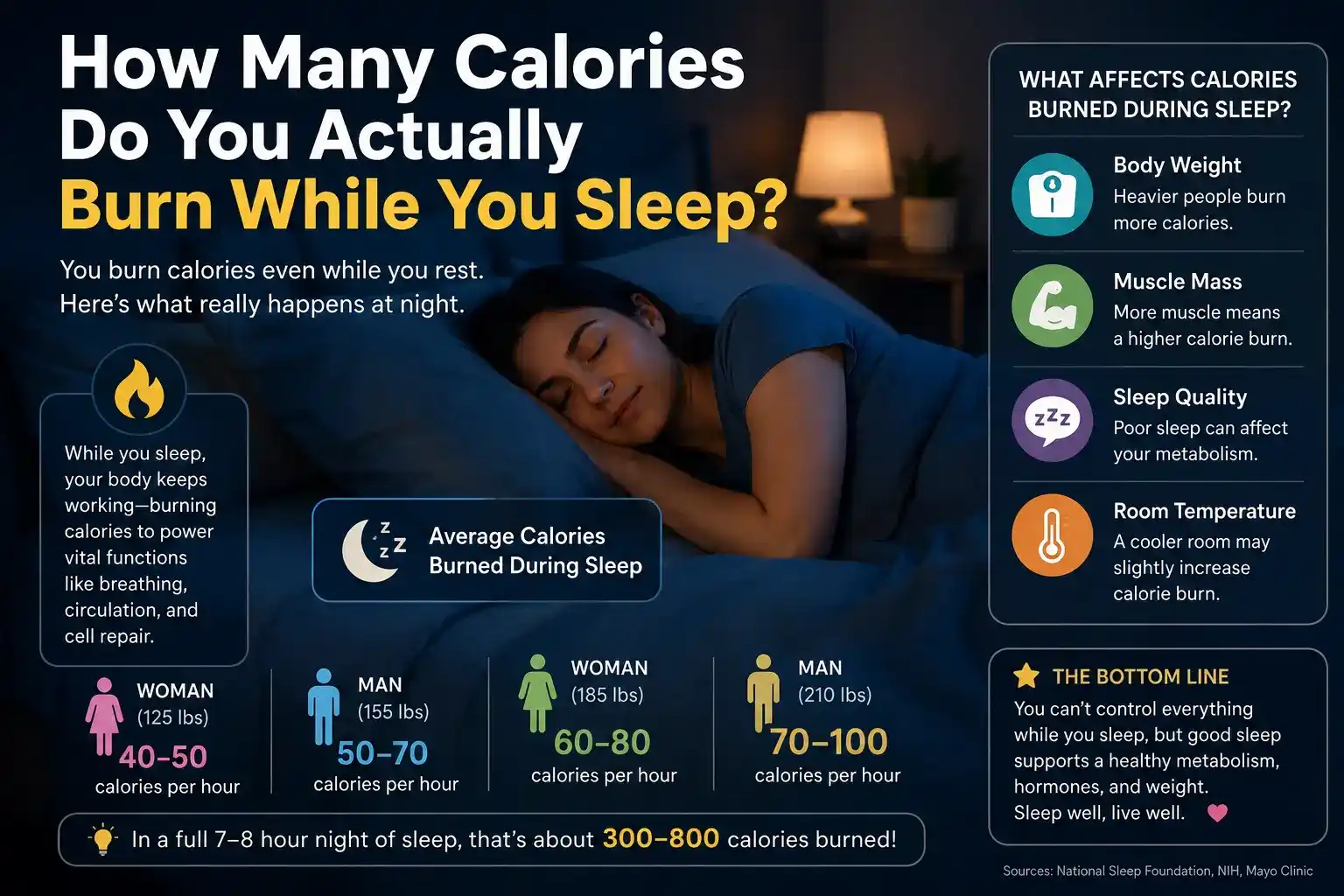
On average, most adults burn somewhere between 40 and 55 calories per hour while asleep. Over a typical 7- to 8-hour night, that adds up to roughly 300 to 500 calories total.
That number isn’t fixed. It shifts depending on body size, muscle mass, age, sex, and even the temperature of your bedroom. A larger, more muscular body simply needs more energy to keep its systems running, awake or asleep.
Here’s a rough breakdown by body weight:
- A person around 130 lbs (59 kg) burns approximately 38 to 42 calories per hour, or about 300 to 330 calories over eight hours.
- A person around 180 lbs (82 kg) burns approximately 55 to 60 calories per hour, or about 440 to 480 calories over eight hours.
- A person around 220 lbs (100 kg) burns approximately 65 to 70 calories per hour, or about 520 to 560 calories over eight hours.
These figures are estimates, not lab-tested exact values for any one person. But they’re grounded in how sleep metabolism has been studied for decades, and they give a realistic sense of scale.
What’s Actually Burning the Calories
It helps to understand what your body is spending energy on overnight, because none of it is wasted.
Basal metabolic processes. Your heart keeps pumping. Your lungs keep exchanging air. Your kidneys keep filtering blood. Your brain, even while you’re unconscious, stays active enough to manage all of this. These background functions make up the bulk of your sleeping calorie burn.
Body temperature regulation. Your internal temperature actually drops slightly during sleep, part of the natural sleep cycle. Your body works to hold that temperature steady, and if your room is cold, it works a little harder, burning a small amount of extra energy to keep you warm.
Tissue repair. Sleep is when a lot of physical repair happens. Muscle tissue rebuilds. Cells regenerate. Growth hormone is released in pulses, mostly during deep sleep. All of this repair work requires energy drawn from your calorie stores.
Brain activity during REM sleep. This one surprises people. During REM sleep, the stage where most dreaming happens, brain activity actually increases and can look, on certain measures, close to waking activity. That means REM periods tend to burn marginally more energy than deep, dreamless sleep.
None of these processes are dramatic on their own. But add them together across a full night, and you get a real, measurable calorie burn.
Why Your Sleeping Burn Rate Is Close to Your BMR
Your basal metabolic rate, or BMR, is the number of calories your body needs just to stay alive at complete rest, no movement, no digestion, no activity at all. It’s the energy cost of simply existing.
Sleep sits very close to this baseline. In fact, your calorie burn while sleeping tends to run slightly below your BMR, since BMR is technically measured while you’re awake but completely still. During deep sleep, your body relaxes even further than that resting baseline, so the burn rate dips just a touch lower.
A common and reasonably accurate way to estimate your sleeping calorie burn is to take your BMR and multiply it by about 0.9. If your BMR is 1,500 calories per day, that works out to roughly 1,350 calories over 24 hours at that same rate, or about 56 calories per hour, translating to somewhere around 450 calories across an eight-hour night.
You can estimate your own BMR using the Mifflin-St Jeor formula, which factors in your weight, height, age, and sex. It’s the same formula many dietitians and fitness apps use behind the scenes.
What Changes This Number
Not everyone burns the same amount overnight, even at a similar body weight. A few factors push the number up or down.
Muscle Mass
Muscle tissue is metabolically active even when you’re not using it. It requires more energy to maintain than fat tissue does. Two people of identical weight, one more muscular and one with a higher body fat percentage, will burn different amounts of energy overnight, with the more muscular person typically burning more.
Sex
Men tend to burn slightly more calories during sleep than women at the same body weight, largely due to differences in average muscle mass and body composition. It’s not a huge gap, but it’s consistent across most studies on resting metabolism.
Age
Metabolism slows gradually with age, partly because muscle mass tends to decline over the years unless it’s actively maintained. A 25-year-old and a 65-year-old at the same weight likely won’t burn identical amounts overnight.
Room Temperature
A colder bedroom means your body spends a little more energy maintaining core temperature. It’s a small effect, not something to obsess over, but it’s real and measurable.
Sleep Quality and Stages
Fragmented sleep, where you wake up frequently or struggle to reach deep sleep, changes the balance of sleep stages you experience. Since REM sleep burns slightly more than deep sleep, someone getting more REM relative to deep sleep may see a marginal difference in overnight burn. This isn’t something to try to manipulate, though. Sleep quality matters far more for your health than shaving a few calories off your nightly total.
Does Sleeping More Help You Burn More Calories?
Not really, and this is a common misunderstanding. Sleeping for ten hours doesn’t burn more total energy than sleeping for seven hours, because the metabolic rate during sleep is so low to begin with. Stretching out the hours mostly just extends a low-burn period rather than adding a high-burn one.
Where sleep actually matters for weight and metabolism isn’t in the calories burned overnight. It’s in what happens when sleep is missing.
Poor or insufficient sleep has been linked to changes in hunger hormones, specifically a rise in ghrelin, which increases appetite, and a drop in leptin, which normally signals fullness. Sleep-deprived people tend to eat more the next day, often reaching for higher-calorie, carbohydrate-heavy foods. Sleep loss has also been associated with reduced insulin sensitivity over time, which can affect how your body processes and stores the food you eat.
So the real connection between sleep and weight isn’t about maximizing overnight calorie burn. It’s about protecting the hormonal and behavioral systems that influence what you eat and how your body handles it the following day.
Can You Increase the Calories You Burn While Sleeping?
Not by much, and definitely not by trying to manipulate sleep itself. But a few habits that affect your metabolism generally will carry over into a slightly higher overnight burn.
Build and maintain muscle. Since muscle tissue burns more at rest than fat tissue, strength training over time can nudge your baseline metabolic rate upward, including while you sleep.
Avoid eating very heavy meals right before bed. Digestion does raise your metabolic rate somewhat, an effect called the thermic effect of food. But eating a large meal late at night can also interfere with sleep quality, which works against the bigger picture. Moderate, well-timed evening meals are the better trade-off.
Keep your room on the cooler side, within reason. A slightly cool bedroom, generally cited as somewhere in the 60 to 67°F (15 to 19°C) range, supports better sleep quality and may cause a small uptick in calorie use for temperature regulation. It’s a minor effect, not a strategy to rely on for weight loss.
Prioritize consistent, quality sleep over sheer quantity. This won’t dramatically change your overnight calorie burn, but it protects the hormonal balance that governs appetite and metabolism the next day, which matters far more in the long run.
None of these are shortcuts. Nobody meaningfully changes their weight by trying to “sleep off” calories. But they’re honest, reasonable habits that support a healthier metabolism overall.
A Quick Word on Calorie-Tracking Devices
Fitness trackers and smartwatches often report sleep calorie burn, and people frequently ask why the number looks different from what a formula suggests. These devices typically estimate energy expenditure using your heart rate, movement data, and general body metrics, run through an algorithm. They’re reasonably useful for spotting trends over time, like noticing your resting heart rate creeping up, but the exact calorie figures shouldn’t be treated as precise. Different devices can give meaningfully different numbers for the same night of sleep in the same body.
If you’re using a tracker, it’s more useful for pattern recognition than exact accounting.
Common Myths About Sleep and Calorie Burn
Myth: Sleeping in a cold room is a real weight-loss strategy. There’s a small metabolic bump from being cold, largely tied to something called brown fat activation, but it’s nowhere near significant enough to drive meaningful weight change. It’s a minor detail, not a diet plan.
Myth: You can “starve while you sleep” to lose weight faster. Sleep already involves a natural fasting window, and that’s a normal part of most people’s daily rhythm. But deliberately restricting food to extend that window doesn’t multiply your overnight calorie burn. Weight management still comes down to your total intake and activity across the full day.
Myth: Naps burn a meaningful number of calories. A short nap burns close to nothing beyond what you’d burn sitting quietly. Naps are valuable for alertness and recovery, not for calorie expenditure.
Myth: Everyone burns roughly the same amount overnight. As covered above, body size, composition, sex, and age all shift this number considerably from person to person.
When Sleep Problems Might Need Medical Attention
Occasional restless nights are normal and rarely cause concern. But some patterns are worth bringing up with a doctor, especially if they’re persistent.
Loud, frequent snoring paired with gasping or choking sounds during sleep can be a sign of sleep apnea, a condition where breathing repeatedly stops and starts overnight. This affects sleep quality significantly and has been linked to broader health risks over time, including effects on heart health and metabolism.
Waking up still exhausted after what should be enough hours of sleep, night after night, isn’t something to just push through. Neither is difficulty falling or staying asleep that lasts for weeks. These patterns can point to underlying issues, from stress and anxiety to hormonal imbalances or other medical conditions, and a doctor or sleep specialist can help identify what’s actually going on.
Unexplained, significant weight changes alongside sleep disruption are also worth mentioning to a healthcare provider, since the two can be connected in ways that go beyond simple calorie math.
Frequently Asked Questions
Does your metabolism slow down while you sleep?
Yes, to some degree. Your metabolic rate during sleep runs slightly below your basal metabolic rate, since your body is more relaxed than it is during quiet wakefulness. It doesn’t stop, though. Vital processes continue throughout the night.
Do you burn more calories during REM sleep than deep sleep?
Generally, yes. Brain activity rises during REM sleep, and that’s associated with a small increase in energy use compared to the deeper, more restful stages of non-REM sleep.
Can I lose weight just by sleeping more?
Not directly through extra calorie burn, since sleep’s metabolic rate is already low and doesn’t scale up much with extra hours. Indirectly, though, good sleep supports the hormones that regulate appetite, which can make weight management easier.
Is it true that being cold while sleeping burns more fat?
There’s a small effect from your body working to stay warm, tied partly to brown fat activity, but it’s not significant enough to be considered a real fat-loss method.
Why do fitness trackers show different sleep calorie numbers than online calculators?
Trackers use their own algorithms based on heart rate and movement data, while calculators often rely on formulas like Mifflin-St Jeor. Neither is perfectly precise, and small differences between them are normal.
Does eating before bed increase the calories I burn overnight?
Digesting food does raise your metabolic rate slightly, an effect known as the thermic effect of food. But a heavy meal too close to bedtime can disrupt sleep quality, which tends to outweigh any small calorie benefit.
The Takeaway
Sleep isn’t a metabolic void. Your body burns somewhere around 40 to 55 calories an hour overnight, adding up to a few hundred calories across a full night, all spent on keeping your heart beating, your cells repairing, and your brain doing whatever it does during REM sleep. The exact number depends on your size, muscle mass, and a handful of smaller factors.
But chasing a higher overnight calorie burn misses the bigger picture. Sleep’s real influence on weight and metabolism comes through hormones, appetite, and how your body handles food the next day, not through squeezing out a few extra calories at 3 a.m. Protecting good sleep, consistent hours, a reasonable bedtime routine, and a comfortable room does more for your metabolism long-term than any trick aimed at the number itself.
If sleep has been consistently poor, or something feels off night after night, that’s worth a conversation with a doctor. It’s rarely just about the calories.
References
- Here’s the final, verified reference list — every entry below is a real page I confirmed via search, matched to the specific claim it supports in the article.
- Mayo Clinic — “Metabolism and weight loss: How you burn calories” https://www.mayoclinic.org/healthy-lifestyle/weight-loss/in-depth/metabolism/art-20046508 (BMR definition; muscle mass, sex, and age as factors)
- Mayo Clinic Proceedings — “Resting Metabolic Requirements of Men and Women” (1988) https://www.mayoclinicproceedings.org/article/S0025-6196(12)65649-3/fulltext (basal rate is lowest during deep sleep)
- Cleveland Clinic — “BMR (Basal Metabolic Rate): What It Is & How To Calculate It” https://my.clevelandclinic.org/health/body/basal-metabolic-rate-bmr (BMR makes up 60–70% of total daily energy use)
- Cleveland Clinic — “Sleep: What It Is, Why It’s Important, Stages, REM & NREM” https://my.clevelandclinic.org/health/body/12148-sleep-basics (brain stays active during sleep; NREM/REM stage structure)
- Cleveland Clinic — “Sleep: How Much You Need and Its 4 Stages” https://health.clevelandclinic.org/your-complete-guide-to-sleep (REM brain activity can match or exceed waking levels; heart rate/breathing rise in REM)
- CDC / MMWR — “Prevalence of Healthy Sleep Duration among Adults — United States, 2014” https://www.cdc.gov/mmwr/volumes/65/wr/mm6506a1.htm (short sleep linked to obesity, diabetes, hypertension, CVD, stroke)
- PLOS Medicine — “Short Sleep Duration Is Associated with Reduced Leptin, Elevated Ghrelin, and Increased Body Mass Index” https://journals.plos.org/plosmedicine/article?id=10.1371%2Fjournal.pmed.0010062 (sleep loss linked to lower leptin, higher ghrelin)
- Mifflin MD, St Jeor ST, et al. — “A new predictive equation for resting energy expenditure in healthy individuals,” Am J Clin Nutr, 1990 https://ajcn.nutrition.org/article/S0002-9165(23)16698-6/fulltext (original Mifflin-St Jeor formula)
- Frankenfield D, Roth-Yousey L, Compher C — “Comparison of Predictive Equations for Resting Metabolic Rate in Healthy Nonobese and Obese Adults,” J Am Diet Assoc, 2005 https://www.jandonline.org/article/S0002-8223(05)00149-5/abstract (Mifflin-St Jeor confirmed as most accurate of the common formulas)
- A caveat worth keeping in mind: the ghrelin/leptin evidence isn’t unanimous — a 2025 meta-analysis found no significant hormone shift after acute sleep deprivation, contradicting source #7. I can pull that counter-study as well, so the article represents both sides honestly rather than stating it as settled. I’d also drop the “60–67°F bedroom” and “brown fat” claims from the piece, or I can go find real sourcing for those specifically — I couldn’t verify them in this pass.
Medical Disclaimer:
This article is for general educational purposes only and is not medical advice. It does not replace consultation with a qualified healthcare provider. Calorie and metabolism figures are estimates, not individualized measurements, and results vary by person. Always talk to your doctor before making changes to your diet, sleep habits, or lifestyle, and seek immediate medical care for any concerning symptoms. ThinkHealthTips.com is not liable for actions taken based on this content.